
- August ranks as the deadliest month for motorcyclists in the United States, posting the highest Riding Risk Score of 100 out of 100.
- June follows closely behind with a risk score of 90 out of 100, while July ranks third at 87 out of 100, highlighting a sustained danger period throughout the peak riding season.
- At the opposite end of the spectrum, the winter months, such as January and February, record the lowest riding risk scores due to reduced riding activity; however, fatal crashes still occur year-round.
The most dangerous time to ride isn’t necessarily during icy winter conditions. Instead, it’s when the roads are dry, the weather feels manageable, and rider confidence peaks. From late spring to early fall, the roads are more congested with motorcycles, resulting in heavier traffic volumes, longer trips, and higher speeds, conditions that consistently lead to more fatal crashes.


The research by a Burbank-based personal injury law firm, the Law Offices of Adrianos Facchetti, analyzed national motorcycle fatality data sourced from the National Highway Traffic Safety Administration’s (NHTSA) Crash Data Analysis and Reporting (CDAN) system from 2019 through 2023 to identify which months expose riders to the greatest risk, factoring in both overall fatalities and crashes involving adverse weather conditions.
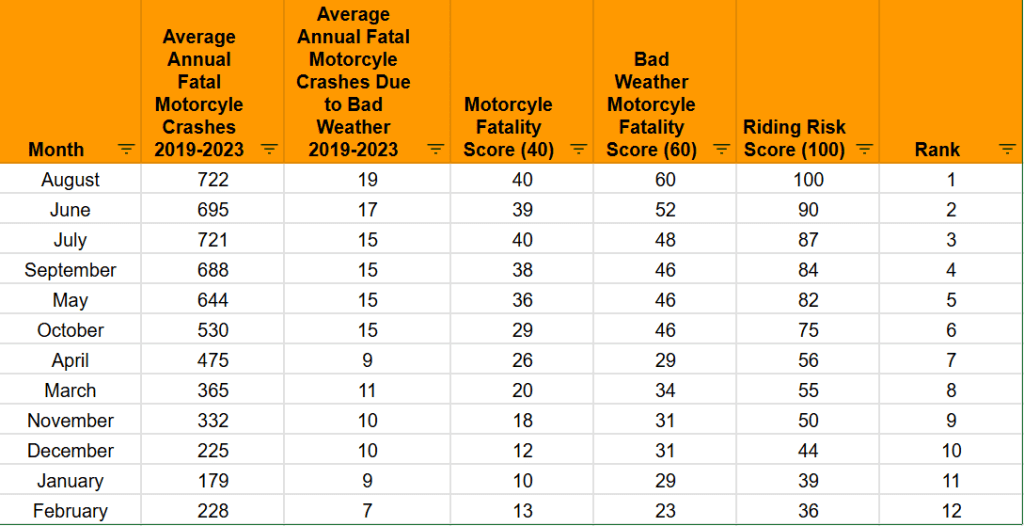
August ranks first with a Riding Risk Score of 100/100 (Motorcycle Fatality Score: 40/40; Bad Weather Fatality Score: 60/60). August recorded an average of 722 fatal motorcycle crashes annually between 2019 and 2023, including 19 deaths linked to bad weather, making it the most dangerous month for riders nationwide.
June ranks second with a Riding Risk Score of 90/100 (Motorcycle Fatality Score: 39/40; Bad Weather Fatality Score: 52/60). June recorded an average of 695 fatal motorcycle crashes annually between 2019 and 2023, including 17 deaths linked to bad weather, placing it among the most dangerous months for riders nationwide.
July ranks third with a Riding Risk Score of 87/100 (Motorcycle Fatality Score: 40/40; Bad Weather Fatality Score: 48/60). July recorded an average of 721 fatal motorcycle crashes annually between 2019 and 2023, including 15 deaths linked to bad weather, as peak summer travel and riding activity elevate crash risks.



Commenting on the findings, a spokesperson from the Law Offices of Adrianos Facchetti said:
“Motorcyclist fatalities rise sharply during warmer months when riding frequency increases and roads become more congested. Dry weather often creates a false sense of security, leading to higher speeds and reduced caution from both riders and drivers. These findings highlight the need for targeted safety campaigns precisely when riding activity peaks.”
September ranks fourth with a Riding Risk Score of 84/100 (Motorcycle Fatality Score: 38/40; Bad Weather Fatality Score: 46/60). September recorded an average of 688 fatal motorcycle crashes annually between 2019 and 2023, including 15 deaths linked to bad weather, extending elevated risk into early fall.
May ranks fifth with a Riding Risk Score of 82/100 (Motorcycle Fatality Score: 36/40; Bad Weather Fatality Score: 46/60). May recorded an average of 644 fatal motorcycle crashes annually between 2019 and 2023, including 15 deaths linked to bad weather, as riders return to the roads in greater numbers.
October ranks sixth with a Riding Risk Score of 75/100, followed by April (7th) at 56/100, March (8th) at 55/100, November (9th) at 50/100, December (10th) at 44/100, January (11th) at 39/100, and February (12th) at 36/100.
Table for Extended Results
What Motorcyclists Can Do During High-Risk Months
Safety experts recommend riders take extra precautions during late spring through early fall:
- Wear high-visibility and protective gear at all times.
- Avoid peak traffic hours and holiday travel when possible.
- Ride defensively and expect driver errors.
- Adjust speed even in fit weather.
- Stay alert during the summer months when crash risks peak.
Methodology
The study analyzed national motorcycle fatal crash data from the National Highway Traffic Safety Administration’s (NHTSA) Crash Data Analysis and Reporting (CDAN) system from 2019 through 2023. Researchers calculated five-year averages for each month to reduce year-to-year volatility. A composite riding risk score (out of 100) was developed using motorcycle fatality volume and fatal crashes involving adverse weather conditions. Months were ranked from highest to lowest risk.
Data Source
- Motorcycle fatal crash data sourced from the National Highway Traffic Safety Administration (NHTSA) Crash Data Analysis and Reporting (CDAN) system: https://cdan.dot.gov/query
- Research Dataset → https://docs.google.com/spreadsheets/d/1h847cdpiGWmyF2SsIa71URaUHgQaUgmQ8PZA6jKno6k/edit?gid=0#gid=0
- Study by → https://facchettilaw.com/