The Los Angeles County Metropolitan Transportation Authority sued the City of Burbank on Tuesday, alleging Burbank is illegally blocking the regional rapid transit project scheduled to open before the 2028 Olympic Games.


The $400 million North Hollywood to Pasadena Bus Rapid Transit Corridor Project (BRT) is a 19-mile line intended to connect the San Fernando and San Gabriel valleys.
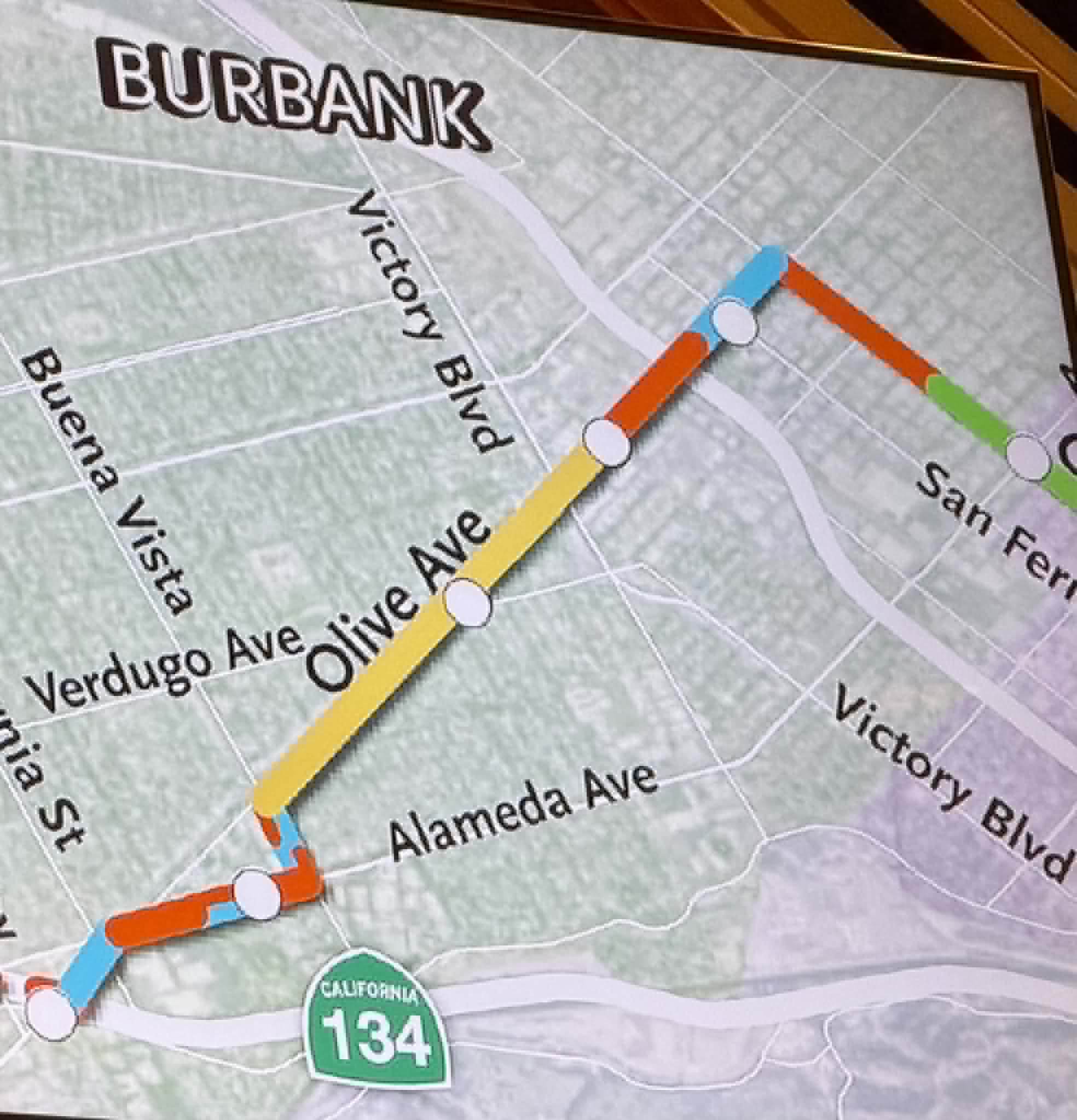
In Burbank, the BRT would run east along State Route 134, northeast on Olive Avenue toward downtown, and southeast on Glenoaks Boulevard toward the Glendale border.
While the route includes dedicated bus lanes to provide “rail-like” speeds, Burbank officials have refused to issue construction permits unless Metro removes those lanes on portions of Olive Avenue or completes a new Environmental Impact Report. (EIR)
THE LAWSUIT
Metro’s complaint says Burbank breached a 2024 cooperative agreement. The agency alleges the city exceeded its authority under the California Environmental Quality Act by using SB 79, a new state housing law, as a “lever” to force design changes and delay the planned February 2028 opening.



The lawsuit asks a court to compel the city to issue permits. Metro argues that because the project’s stations already qualified as transit stops before SB 79 passed, the law is not “new information” requiring a second environmental report.
Metro did not specify damages but cited $43.7 million already spent and $61,250 in lost fare revenue for each workday the project runs late.
SENATE BILL 79
Burbank’s concern centers on Senate Bill 79, a state law taking effect July 1, 2026, that allows higher-density housing near transit stops.
At a special City Council meeting Wednesday, Assistant Community Development Director David Kriske said SB 79 does not apply to every bus stop. The law’s “supercharged” building rules, he said, are triggered only if a station is served by “full-time dedicated bus lanes.” In Burbank, qualifying sites could allow developers to build up to 85 feet high, about eight stories, overriding local height limits.
“The law prescribes minimum densities and heights that may exceed local regulations, and in many places will exceed local regulations,” Kriske said.
RESIDENTS WEIGH IN
Nearly 100 people attended the special council meeting to comment on the project.
“Dropping six-story, zero-lot-line buildings into our neighborhoods destroys the city’s visual harmony,” one resident said. “To stop SB 79 density mandates, we must fight Metro’s dedicated bus lanes.”
Other residents who support the dedicated lanes said the city is ignoring a housing crisis.
“The BRT and resulting effects of SB 79 are going to benefit so many more individuals than the folks that are here,” another resident said. “Please don’t punish this project because of poor planning.”
COUNCIL RESPONDS
Council members voiced concerns about the lawsuit during the special meeting.
Vice Mayor Zizette Mullins said she wanted to escalate the fight.
“I am willing to fight for this city,” Mullins said. “I heard these people loud and clear. I want to sue them back.”
Mayor Tamala Takahashi and Council Member Nikki Perez said losing the lawsuit would mean losing local control over both the transit project and housing density triggered by SB 79.
They suggested exploring a peak-hour bus lane compromise which would allow the BRT to use a dedicated lane during the heaviest commute times such as as 6:00 a.m. to 10:00 a.m. and 4:00 p.m. to 7:00 p.m. Outside of those hours, the lanes would remain open to regular car traffic.
Councilmember Konstantine Anthony, who supports the dedicated lanes, argued that “the only solution out of congestion is mass transit” and warned the city was “kicking the can down the road.”
Councilmember Christopher Rizzotti said he wanted community input on peak-hour dedicated lanes. But City Attorney Joseph McDougall said that option was no longer feasible once the lawsuit was filed.
“This case will proceed on course and it will be tried in the courts, and the community doesn’t have a vote in the court,” McDougall said. “The judge makes a decision based on the arguments, the weight of the evidence, and the law.”
Editor’s Note: You can read the entirety of the lawsuit METRO filed HERE