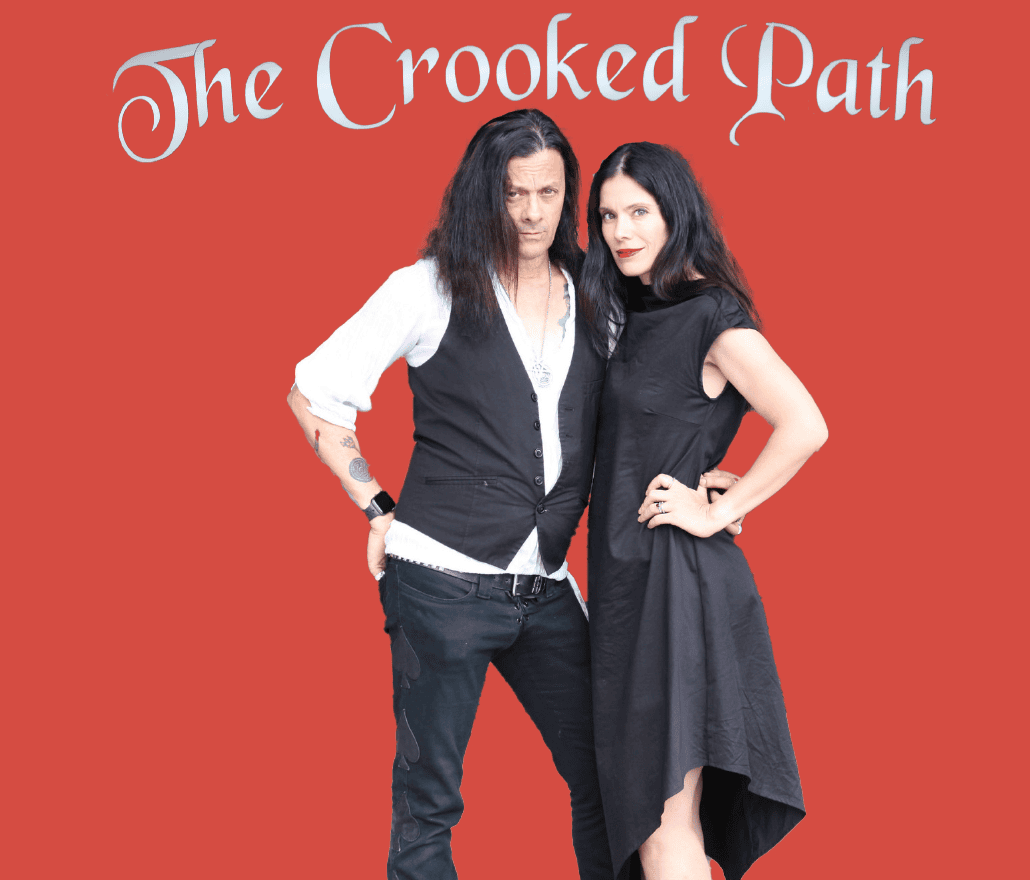
There is something deliberately theatrical about The Crooked Path.


Located in Burbank, California, the shop is part occult formulary, part classroom and part gathering place. At its center is Salvatore Santoro, a 62-year-old practitioner whose journey through witchcraft, ceremonial magic and the left-hand path stretches back nearly five decades.
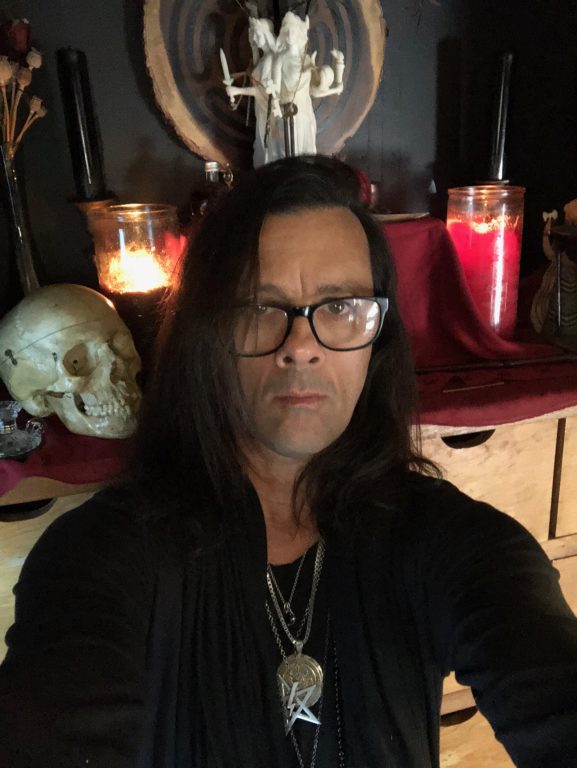
Santoro grew up in Massachusetts and New Hampshire during the 1970s. His interest in the occult began when he was still a child, around 1974 or 1975. One of his early influences was Paul Huson’s Mastering Witchcraft, which introduced him to practical approaches to witchcraft. Soon afterward, he discovered Aleister Crowley’s 777.
“I was a teenager,” Santoro recalls. “I really didn’t know what the hell I was doing.”
At first, his interest existed alongside the usual cultural influences of the era—rock and roll, rebellion and experimentation. But what began as youthful curiosity gradually became a serious pursuit.



Santoro moved to Los Angeles in 1985 at age 21. By 1988, he had discovered Eye of the Cat in Long Beach, where he studied witchcraft with Judith Efrain. He eventually became an intern at the store, gaining firsthand experience in a community that operated largely through books, teachers and face-to-face relationships.
The absence of the internet was significant. Information had to be found.
While browsing in a bookstore, Santoro encountered a book about the Hermetic Order of the Golden Dawn. A leaflet fell from the book with a telephone number for a Golden Dawn organization in Fontana. He called. Months later, the organization contacted him, and he eventually joined.
His time with the order lasted about three years and ended after a conflict with its leadership.
“I kind of go against the grain,” he says.
The experience did not stop him. Instead, it sent him further into Los Angeles’ occult underground.
In the mid-1990s, Santoro and his cousin opened a small shop called Talisman Times in Eagle Rock. The store survived only about three months, but its closing produced an unexpected opportunity. A man named George Darby purchased the remaining inventory and offered Santoro a job.
Darby owned Pan Pipes, which Santoro describes as the oldest formulary in Los Angeles.
Santoro became his assistant. The work included sweeping floors, running errands and picking up dry cleaning, but the less glamorous responsibilities gave him something more valuable: access.
He learned.
During his time at Pan Pipes, Santoro also briefly encountered Anton LaVey, founder of the Church of Satan. Their conversation was short, but one sentence stayed with him.
“Don’t be a parrot.”
For Santoro, the advice became a useful principle: study traditions without simply becoming an imitation of someone else.
After Pan Pipes, Santoro moved through other parts of the Los Angeles occult community, including Raven’s Flight in North Hollywood. By the early 2000s, he had stepped away from the storefront world. He continued practicing, eventually returning to the idea that had been with him for years: owning his own occult shop.
That opportunity arrived in 2015.
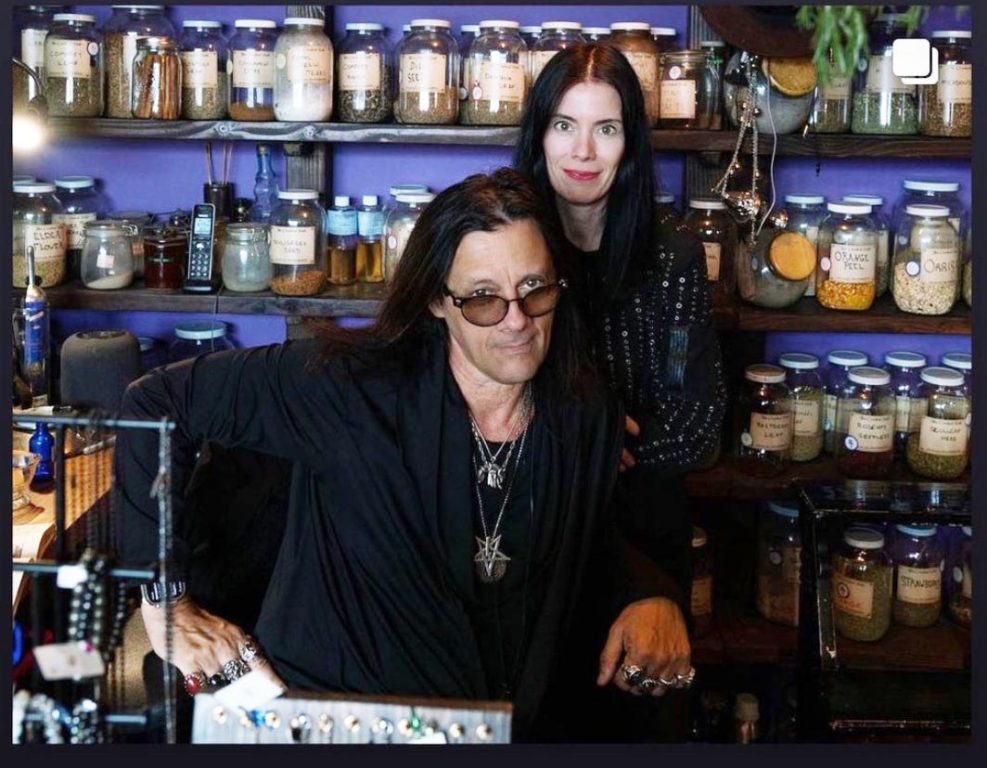
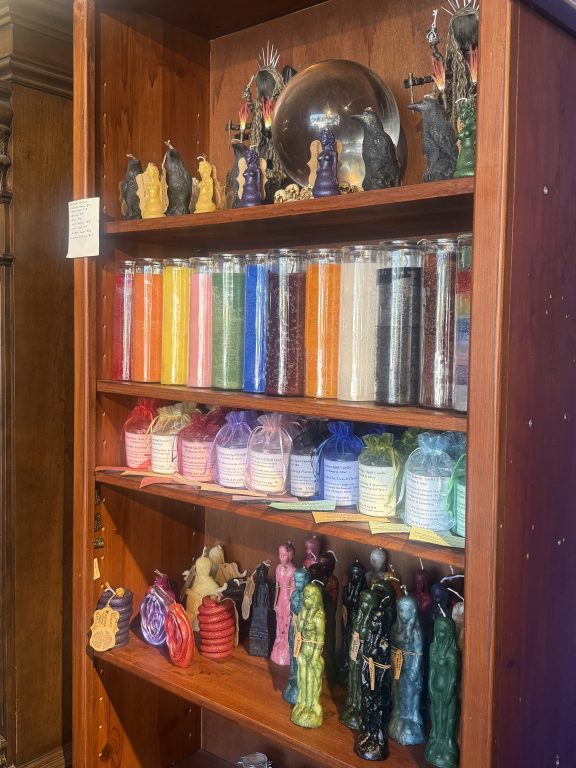
Santoro and his wife, Popi Mavros, opened The Crooked Path. What began as a small, roughly 600-square-foot shop stocked with candles, herbs and oils eventually grew into a larger business combining retail, education and ritual practice.
Mavros brought something Santoro openly acknowledges he did not have: business experience.
Originally from Canada, Mavros had spent years in technology and corporate America. She eventually became instrumental in turning Santoro’s concept into a functioning business.
“Had I done this alone, it would have failed within a year,” Santoro says.
Their partnership became one of the defining elements of The Crooked Path.
Today, Santoro teaches a ten-week witchcraft course twice a year and estimates that more than 400 students have passed through his classes. He also teaches shorter courses covering subjects such as hex craft, spellcraft and planetary magic.
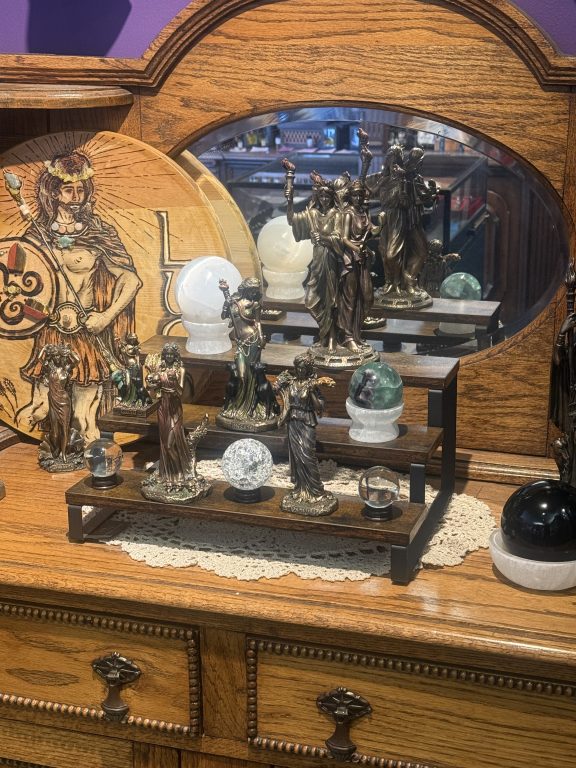
The store is dedicated to the goddess Hathor, a connection that grew from Santoro’s spiritual experiences and his wife’s family connection to the island of Crete. The business also became the home of the Order of the Dark Moon, a group largely composed of former students, with Santoro serving as its high priest.
But Santoro’s approach to teaching is less about presenting a single universal system than explaining how different systems can be understood and practiced.
“Witchcraft has really no direction,” he says. “Every college has different rules.”
His own practice emphasizes spellcraft and draws from several traditions, including Hermetic philosophy, the Kabbalistic Tree of Life and planetary magic. He works with symbolic correspondences involving planets, days of the week, colors, candles, oils, herbs and other materials.
He describes the process in surprisingly practical terms.
“Spellcraft is math,” he says. “It’s making pizza. It’s making a pie.”
The seven classical planets provide one of the foundations of his system.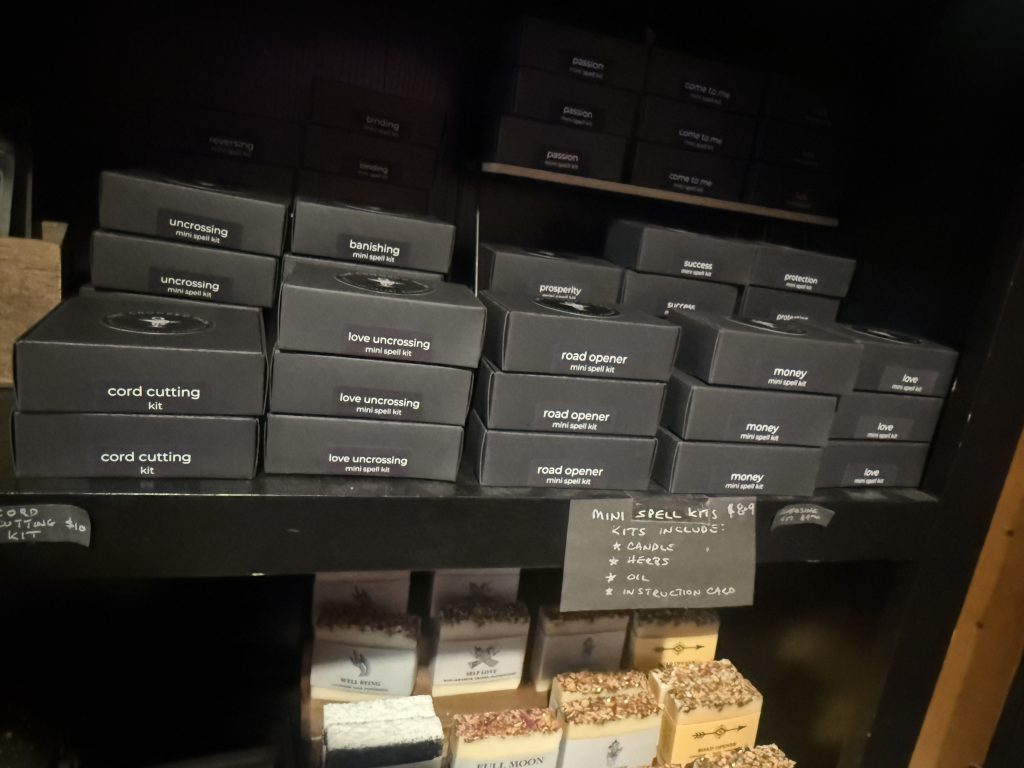
Monday corresponds to the Moon, associated with protection, psychic development and clearing. Tuesday belongs to Mars, connected with passion, conflict, sexuality and action. Wednesday is Mercury, associated with communication, science, mathematics, technology, music and the arts.
Thursday belongs to Jupiter and encompasses prosperity, luck, legal matters and expansion. Friday is Venus, associated with love, attraction and desirable objects. Saturday is Saturn, representing binding, banishing and restriction. Sunday belongs to the Sun, connected with clarity, intellect and cleansing.
From there, the practice becomes increasingly detailed, incorporating colors, herbs, oils and other correspondences.
The framework is rooted in Hermetic philosophy, particularly the principle commonly expressed as “as above, so below.” Santoro describes ritual as a way of focusing conscious attention and directing it toward the subconscious.
But he is equally clear about the limitations of spellcraft.
“Spell work is not 100%,” he says.
Santoro estimates his own professional success rate at roughly 36 percent. Rather than presenting magic as an absolute guarantee, he treats it as one tool among many.
For him, part of the discipline is knowing when to stop concentrating on the desired result.
He connects this idea with the principle of silence. The intention must eventually be released rather than constantly revisited. Obsessing over whether a spell is working, in his view, undermines the very process.
That practical attitude carries into his professional work.
When people hire him, Santoro says, he can move beyond the basic structure of correspondence and bring intuition into the process. That is where he sees the artistic element emerging.
“There’s an art to it,” he says.
He compares spellcraft to a martial art. It involves discipline, technique, timing and an understanding of the psyche and environment. The artistic component comes from knowing when to follow a system and when to make an intuitive adjustment.
It is an approach that fits Santoro’s personality. He has little interest in presenting himself as solemn or mysterious for its own sake. He openly describes himself as someone drawn to spectacle, theatricality and contradiction.
His early attraction to Catholicism provides an unlikely clue.
As a child, Santoro became fascinated with the Gothic atmosphere of the church. He became an altar boy and briefly imagined becoming a priest. Then his father explained that the priesthood meant giving up marriage and romantic relationships.
Santoro reconsidered.
His conclusion was characteristically blunt.
“I realize that what I want to be is God. I don’t need the middle man.”
The joke contains something more serious about his lifelong relationship with spirituality. Santoro separates his personal theology from his magical practice. He maintains a private spiritual practice while approaching spellcraft as a distinct discipline.
That separation also helps explain why The Crooked Path accommodates people from very different traditions.
Santoro describes his relationship with Griffin, a longtime figure associated with the Green Man, as an example. He speaks of Griffin with admiration, describing him as an elder, former priest and friend. But he sees their establishments as serving different purposes.
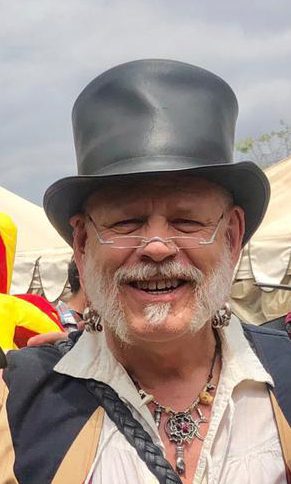

The Green Man has its own traditions and emphasis, while The Crooked Path offers a different approach.
“We are not competition,” Santoro says.
The distinction is important in a community where different schools of thought can sometimes be treated as competing territories. Santoro instead sees room for multiple approaches.
The Crooked Path also reflects that philosophy in its clientele. The shop has welcomed practitioners interested in witchcraft, ceremonial magic, Satanism and the left-hand path.
For Santoro, the common denominator is curiosity.
And that curiosity extends beyond the shop itself.
He is constantly developing ideas, thinking about new projects and considering ways to make information more accessible. Mavros shares that restless creative energy, bringing her own ideas and business perspective to the operation.
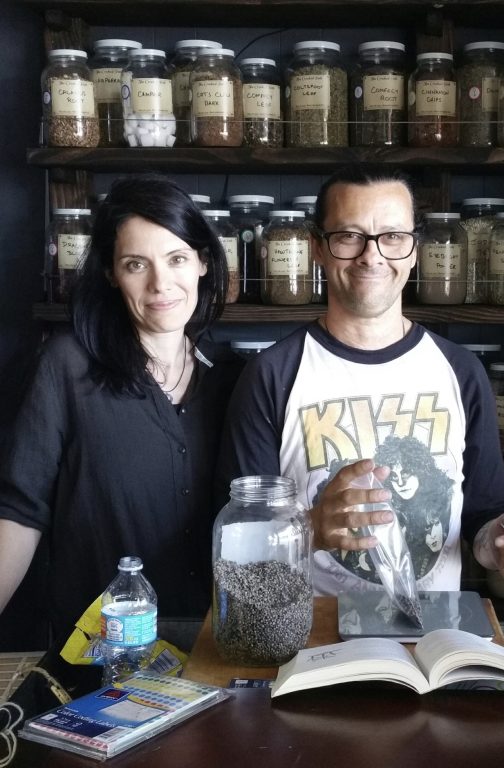
Their partnership is therefore more than a division of responsibilities. It is a meeting of two very different skill sets.
Santoro provides the magical knowledge and creative direction. Mavros provides the organizational and business framework that allows those ideas to become tangible.
Together, they have built something that is unusual even by Los Angeles standards.
And then there is Burbank.
Santoro speaks about the city with the affection of someone who has found a place that feels familiar. Having grown up in New England, he sees something of those communities in Burbank.
He describes the city as a “microcosm”—a place where neighborhoods, businesses and civic institutions still feel connected.
For a store devoted to practices that can sometimes exist on the margins of mainstream culture, that sense of community has mattered.
The Crooked Path may specialize in occult traditions, but its daily life is remarkably human: customers come through the door, students gather for classes, ideas are exchanged and people pursue questions that have fascinated them for generations.
Santoro’s own journey explains much of the shop’s character.
He began as a curious kid reading books in New England. He became a student, an apprentice, a shopkeeper and a teacher. He experienced disagreements, changed directions and continued learning.
Nearly five decades later, he has created a place where that accumulated experience can be shared.
The name is fitting.
Santoro’s path was never particularly straight. It moved from Catholicism to witchcraft, from Massachusetts to California, from bookstores to occult shops, from apprentice to teacher, and eventually from student to owner of The Crooked Path.
For Santoro, the journey is still moving.
There are always more books to read, more ideas to test, more students to teach and another turn somewhere ahead.
That may be the real lesson of The Crooked Path: not that there is one way to reach an answer, but that the unexpected route can sometimes become the most interesting one.
Originally published in www.theburbankblabla.com