Burbank has had its share of aviation pioneers, but few had ideas as unusual as Maurice Poirier. In the late 1920s and early 1930s, he was experimenting with rocket-powered airplanes, radio-controlled miniature aircraft, and even a rocket he believed could travel more than 200 miles above Earth.


Poirier attracted attention from popular science magazines, which featured his unusual designs and ambitious predictions.
In January 1929, Modern Mechanix introduced readers to Poirier’s proposed rocket-powered airplane. The magazine described a conventional aircraft fitted with 86 gun-barrel attachments containing rockets. Poirier expected the force of the explosions to propel the plane to approximately 400 mph. Regular gasoline engines would still be used for takeoffs and landings.
The February 1929 issue of Science and Invention also featured Poirier’s design, showing a model airplane equipped with 86 rocket gun barrels.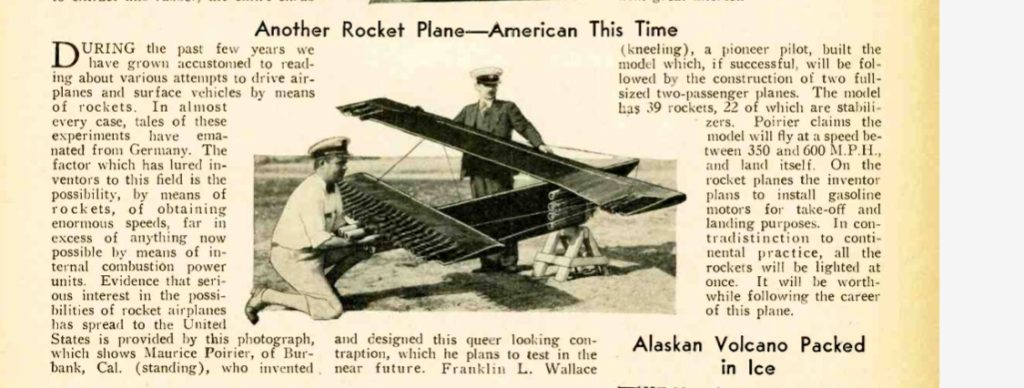
A few months later, the April 1929 issue of Science and Invention featured another of his experiments: a miniature rocket-powered airplane. The publication reported that Poirier had successfully controlled the small aircraft by radio. It was described as a Fokker-type trimotor.



By January 1931, Poirier was working with Franklin L. Wallace, identified in the magazine as a pioneer pilot.
Science and Invention published a photograph of the two men with a rocket-plane model. The publication reported that the model contained 39 rockets, including 22 intended to serve as stabilizers.
Poirier predicted the model could reach speeds between 350 and 600 mph and land itself. He also envisioned eventually building full-sized, two-passenger aircraft based on the design. Gasoline engines would be used for takeoffs and landings, while the rockets would provide additional propulsion.
The project did not go entirely according to plan. A Jan. 29, 1931, report in the Helena Independent described a test of a 12-foot model that was launched from a hilltop using an elastic rope. The aircraft became tangled in wires and crashed, with its rocket exploding on impact. Poirier reportedly intended to build a larger model and continue his experiments.
Poirier’s ambitions extended beyond airplanes.
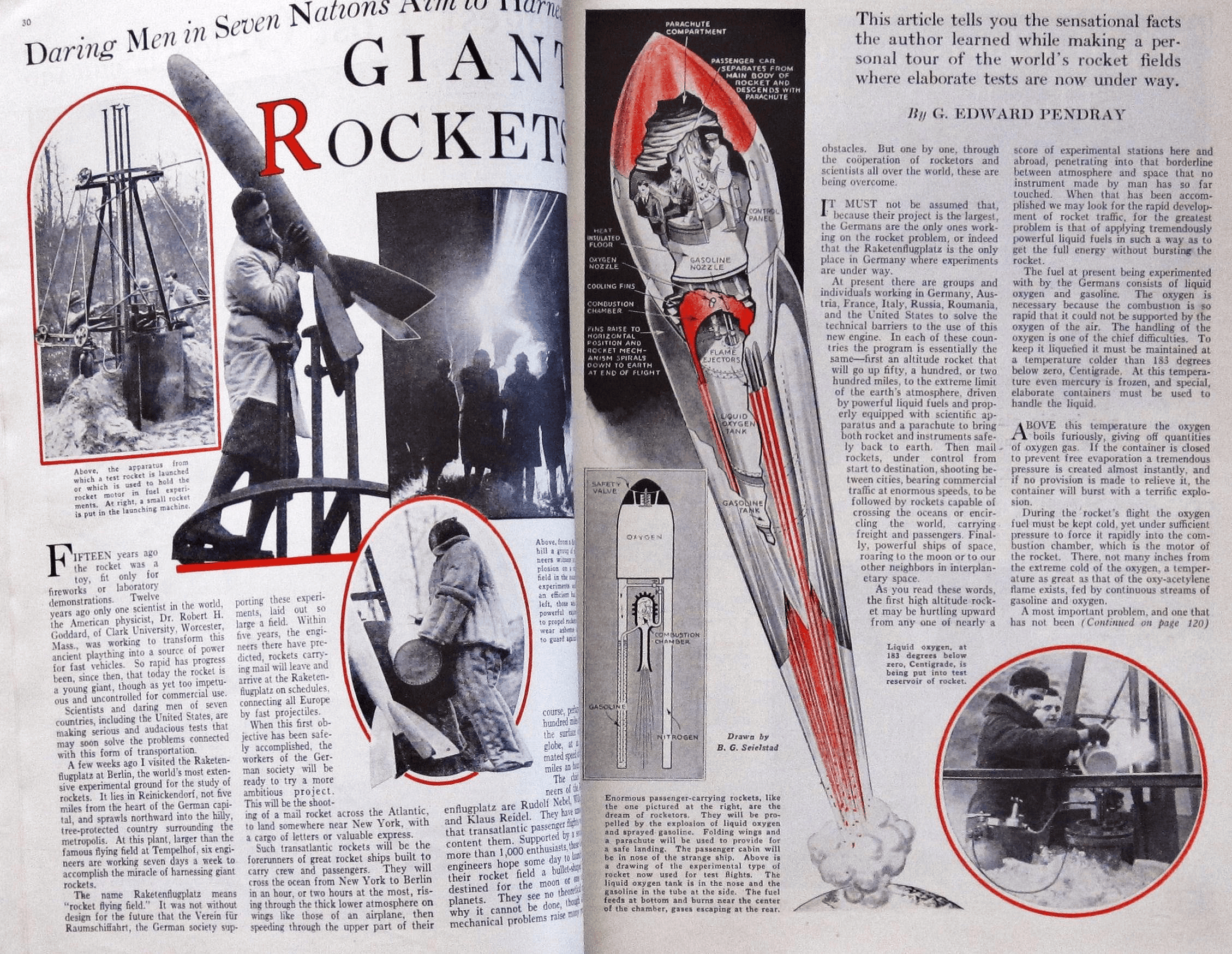
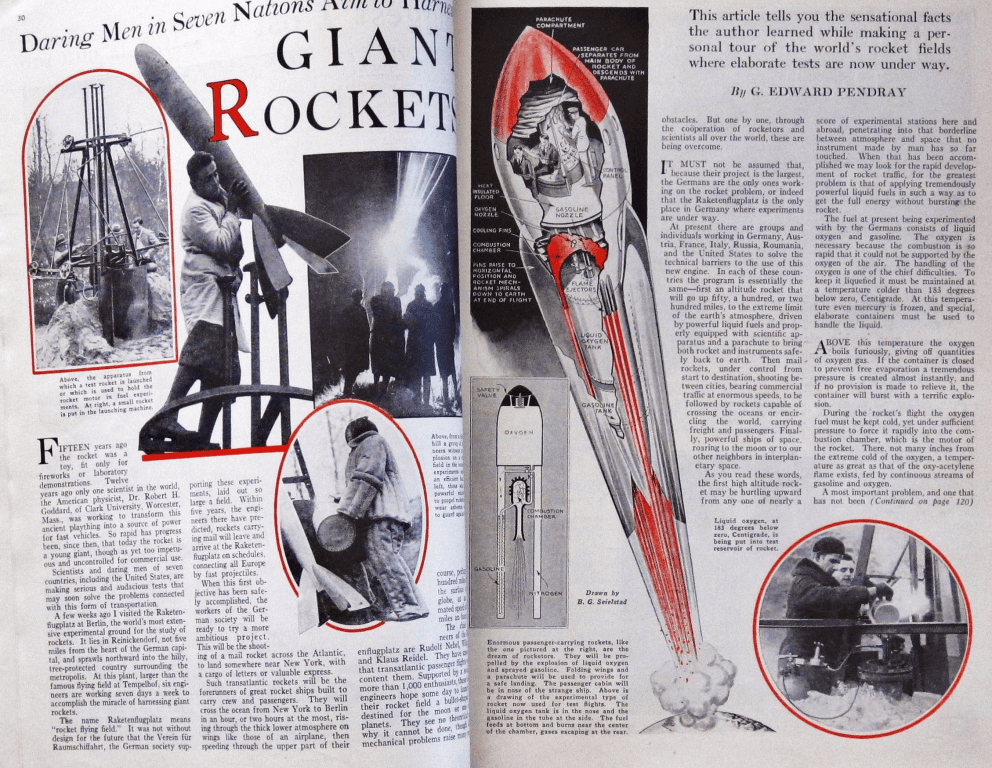
A September 1936 article in Modern Mechanix described another of his proposals: a stratospheric research rocket designed to carry scientific instruments. The publication reported that Poirier claimed the 175-pound rocket could reach an altitude exceeding 200 miles.
His proposed design included a parachute intended to return the instruments safely to Earth after the rocket reached its maximum height. The rocket itself was designed to explode at that point, according to the magazine.
The publication also reported that the rocket’s power would come from mixing two gases known only to the inventor. No launch date had been set.
There is an important distinction between what Poirier proposed and what he actually accomplished. The surviving magazine accounts document his designs, models, predictions, and at least one failed test. They do not establish that his full-sized rocket aircraft or high-altitude research rocket ever flew successfully.
Still, his appearance in several national science publications makes him an intriguing figure in Burbank’s early aviation story.
Today, Burbank is closely associated with the aircraft industry and the entertainment business. But decades before the city became synonymous with major aerospace and aviation companies, Poirier was imagining ways to push flight beyond the limits of conventional engines.
His proposed machines may never have achieved the extraordinary speeds he predicted. But his unusual experiments earned a place in the popular science magazines of his day — and left behind a curious chapter in Burbank’s history.