Updated 7/17/26 at 5:30 pm – The City of Burbank just released the following update:


Late today, the Court issued a ruling denying Metro’s Motion for Preliminary Injunction. The next scheduled Court date at which the Court will hear the City’s Demurrer motion and hold a Case Management Conference is now scheduled for August 19.
As the case is still pending, there will be no further comments at this time
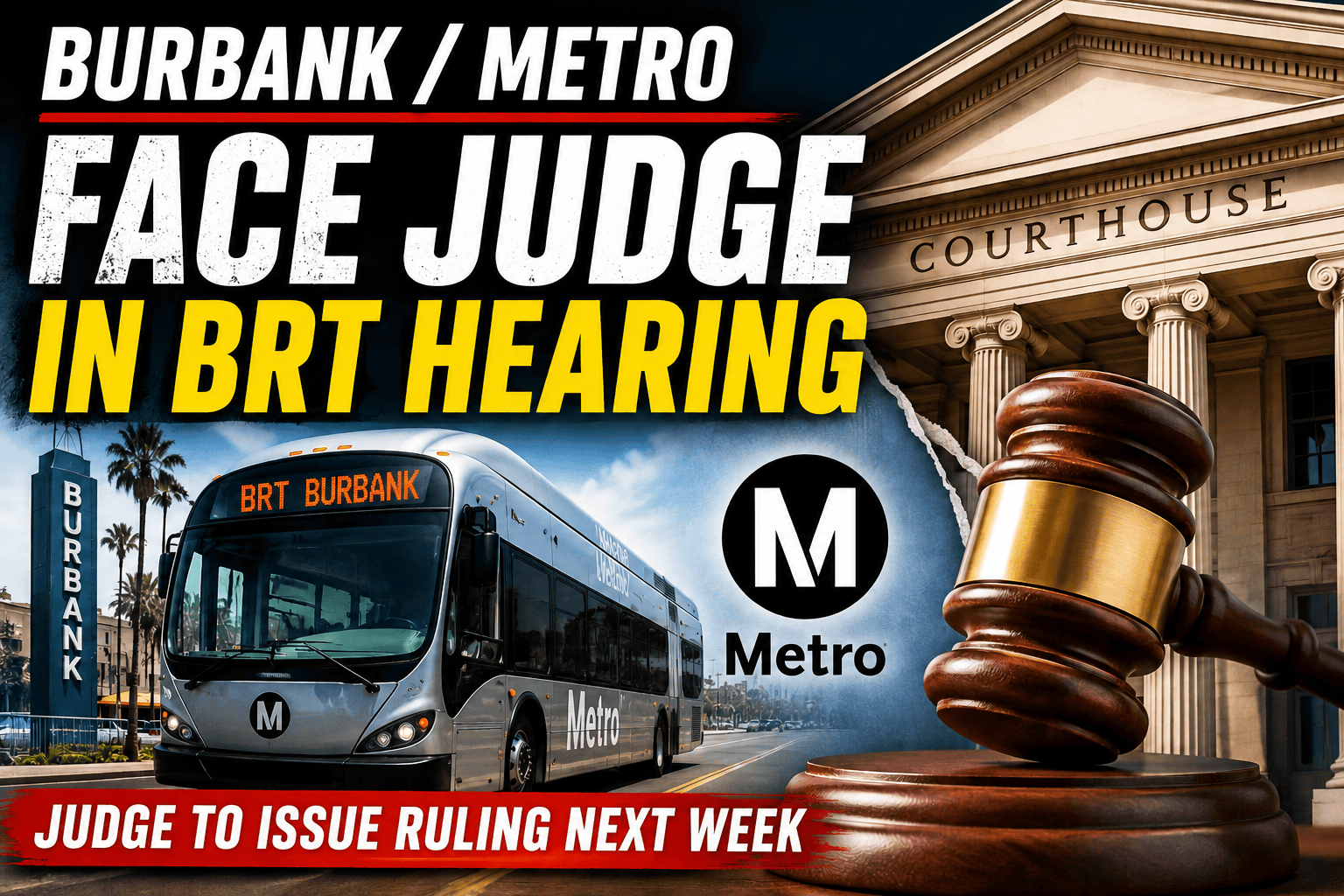
The fate of a critical Los Angeles transit project now hangs in the balance as the region awaits a judge’s final word. Just yesterday, on July 16, 2026, legal counsel for the City of Burbank appeared in Los Angeles Superior Court to push back against the Honorable Stephen Morgan’s tentative ruling. The judge’s preliminary stance leaned toward granting the Los Angeles County Metropolitan Transportation Authority (Metro) a preliminary injunction, a move that would force the city to issue stalled construction permits. After hearing passionate arguments from both sides regarding local control and regional transit needs, Judge Morgan took the matter under submission. A final ruling on the injunction is expected next week, and the City of Burbank has stated it will offer no further public comment until then.
This courtroom showdown is the culmination of a bitter dispute over the 19-mile North Hollywood to Pasadena Bus Rapid Transit (BRT) project.



The story begins with a promise to Los Angeles commuters. Fueled by Measure M funding approved by voters in 2016, Metro set out to slash travel times between the San Fernando and San Gabriel Valleys from a grueling two hours down to a brisk 70 minutes. With an opening date slated for February 2028—just ahead of the Los Angeles Olympic and Paralympic Games—the BRT was designed to serve an estimated 35,000 daily riders with a high-speed, rail-like experience. To achieve this ambitious goal, Metro needed to pull buses out of LA’s notorious traffic by utilizing dedicated bus lanes.
By October 2024, Metro and Burbank signed a Cooperative Agreement to expedite the design and permitting for the segments running through the city. However, the partnership was fraught from the start. Burbank officials and residents had long voiced opposition to dedicating travel lanes exclusively to buses, particularly along the Olive Avenue corridor. They feared that eliminating vehicle lanes would severely congest the street and push frustrated drivers into quiet residential neighborhoods to bypass the traffic.
The simmering tension finally exploded in late 2025 following the passage of California Senate Bill 79. Aimed at addressing the state’s housing crisis, SB 79 mandated significant upzoning for high-density residential development near qualifying “transit-oriented” stops. Crucially, the law specified that a stop only qualifies if the buses operate in full-time dedicated lanes.
In early 2026, Burbank city officials evaluated the new law and realized that Metro’s dedicated bus lanes would automatically trigger SB 79’s massive density increases around five of the six proposed BRT stations within city limits. Alarmed by the potential strain that unchecked housing density would place on the city’s sewer, water, and electrical infrastructure, Burbank drew a line in the sand and halted all construction approvals.
The city issued an ultimatum to Metro: the transit agency must either conduct a completely new, time-consuming environmental review under the California Environmental Quality Act to analyze the impacts of this new housing density, or strip the dedicated bus lanes from the project entirely to avoid triggering the state law.
Metro flatly refused. The transit agency argued that SB 79 was a state housing mandate, not a transit project impact, and that forcing them to analyze hypothetical future housing developments completely inverted environmental law. Furthermore, Metro argued that stripping the dedicated lanes would destroy the BRT’s core promise of speed and reliability.
With $43.7 million already invested in design and procurement, and the Olympic deadline rapidly approaching, the formal dispute-resolution process collapsed. Metro claimed Burbank was holding the regional transit project hostage over local zoning grievances. On May 19, 2026, Metro officially sued the City of Burbank for breach of contract, asking the court to compel the city to issue the necessary construction permits without the extra environmental red tape.
Now, the legal clock is ticking. Next week’s ruling from Judge Morgan will either clear the road for the 2028 Olympic transit timeline or slam the brakes on one of LA County’s most anticipated infrastructure projects.