Plans for the summer construction of the North Hollywood to Pasadena Bus Rapid Transit (BRT) are in motion, but not without pushback from some Burbank residents concerned about what the project could mean for traffic — and the neighborhoods around it.


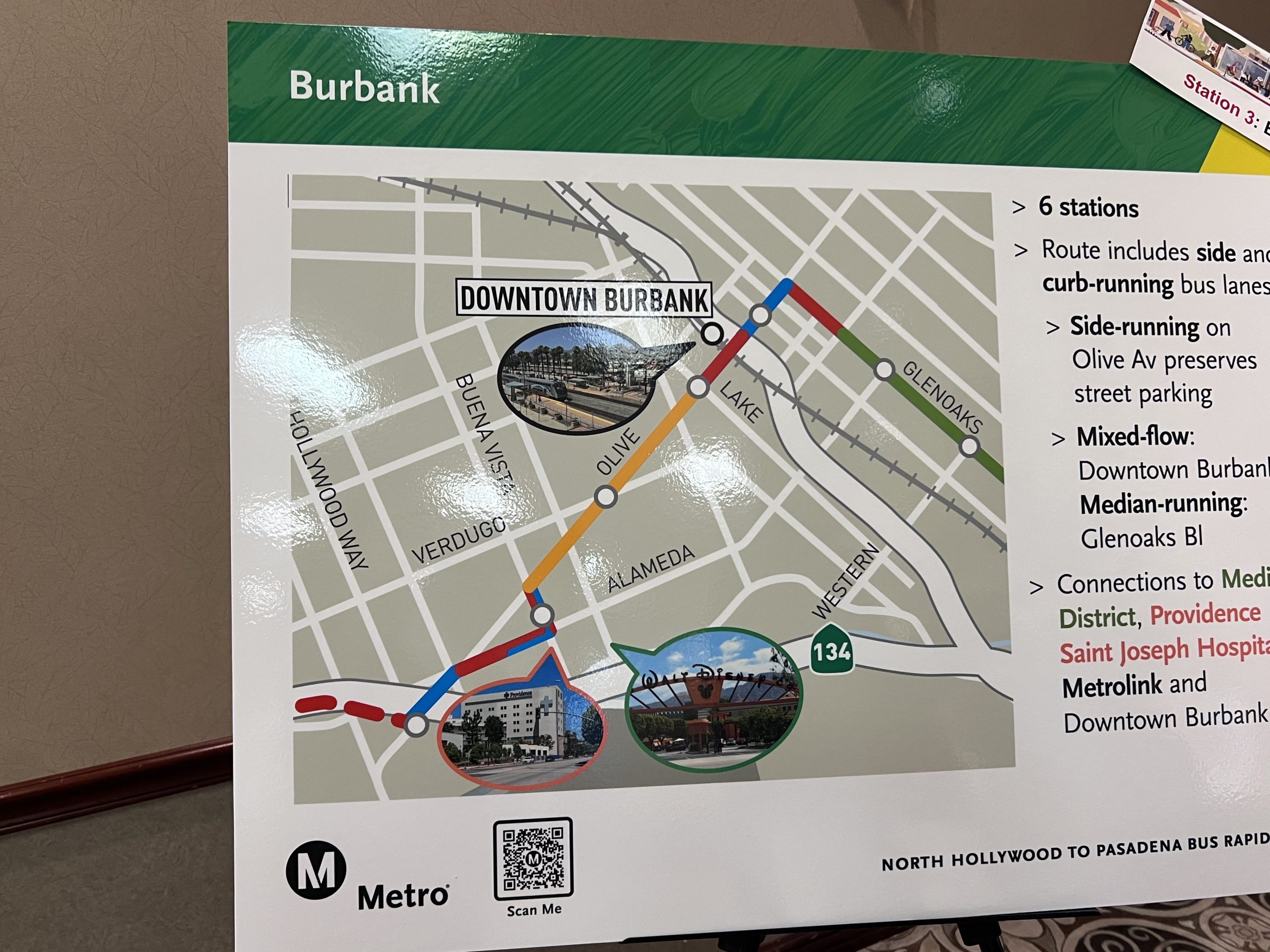
The roughly 19-mile route will stretch through North Hollywood, Burbank (cutting through the Entertainment District and Downtown), and Glendale before ending in Pasadena.
Anthony Defrenza, a deputy executive officer at Metro and project manager, said they’ve completed about 85 percent of the project design, packaged by segment for review by each jurisdiction along the route.
Metro held an open house event at the Buena Vista Branch Library on Monday to talk about the project and answer questions from residents.
At the center of the debate is Olive Avenue.



The project’s plan to modify the thoroughfare sparked backlash from some residents, as Metro’s current design would remove one traffic lane in each direction for dedicated bus use.
“Olive Avenue is a very highly trafficked artery that goes through the city of Burbank,” David Donahue, President of Vision Burbank said. “If you take it down the one lane in each direction, I think it’s going to really dramatically affect how quickly people can get from one side of the city to the other. And I don’t believe that members of the city council really care about that.”
However, not everyone shared that concern.
Phillip Dezonia, a Burbank resident, said he was excited about the project gaining ground.
“I could walk to downtown Burbank, catch a line to the Gold Line and then I can see my friends in Torrance,” Dezonia said.
He added that he supports a designated lane because mixed-flow segments might “spoil the entire vision” by trapping buses in the same traffic they’re trying to avoid.
Hunter Gibson, who commutes by bike but relies on the bus during bad weather, agreed. “Right now it’s two connections — this will be one set ride,” Gibson said. “It’ll drive super close to my office.”
Beyond the lane debate, a separate concern has emerged around legislation.
Donahue and former Burbank mayor Emily Gable-Luddy raised worries about the recent passage of the Abundant and Affordable Homes Near Transit Act, or Senate Bill 79, which passed into law last October.
“[SB 79] specifically says that if there’s a BRT stop, the density around that BRT stop for a half mile will significantly exceed the densities that exist in our four cities today — that’s Glendale, Pasadena, Los Angeles and Burbank,” Gable said. “That particular environmental impact that will occur as a result of each station stop has not been adequately studied and it wasn’t disclosed or discussed when this bus line was originally promised.”
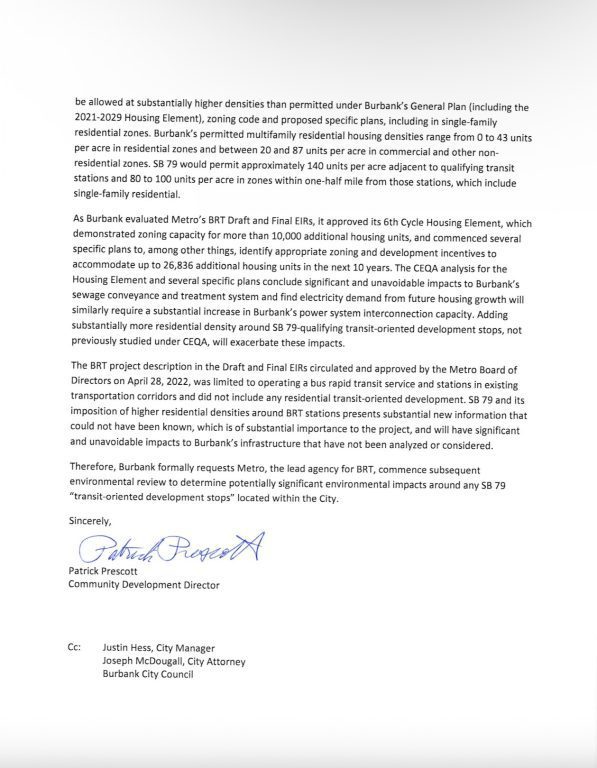
The City of Burbank wrote a letter to Metro in January requesting a new environmental impact report on those grounds. 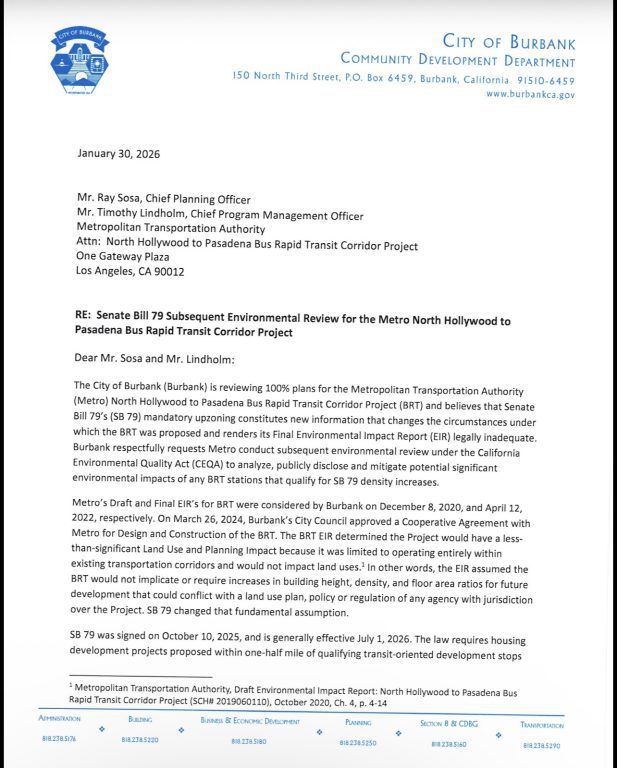
Metro, however, says the existing review was sufficient.
Anthony Crump, executive officer for communications and community relations at Los Angeles Metro, said the agency had completed an environmental impact report.
“As part of that environmental impact report under the California Environmental Quality Act, we analyzed a number of different potential impacts as well as known impacts,” Crump said. “At that time, the report was certified by the Metro board of directors and deemed complete, and then we began with the final design on this particular project.”
As of Tuesday, March 17, the City of Burbank shared the following statement, reflecting its position as the two sides continue to negotiate:
“The City of Burbank continues to work cooperatively with Metro on the North Hollywood to Pasadena Bus Rapid Transit (BRT) project and supports efforts to improve regional transit connections. At the same time, the City has requested that Metro conduct additional environmental review in light of Senate Bill 79, which introduces potential housing density increases near BRT transit stops that were not evaluated in the project’s original environmental analysis and may impact local infrastructure and services. As the project moves forward, Burbank also continues to express a preference for BRT operations that utilize mixed-flow traffic on Olive Avenue between Buena Vista Street and Lake Street to help maintain roadway flexibility and prevent increased congestion that risks pushing cut-through traffic into adjoining neighborhoods, while still supporting improved transit service for our community.”