






Letter to the Editor:



On July 16, Burbank, Glendale and Pasadena City Councils went on record in opposition to Senate Bill 79 (SB79), and I thank them.
SB 79 is currently before the State legislature and will be taken up again when our legislators return to Sacramento on August 18. It proposes to increase housing density by permitting taller residential buildings near major transit stops. It will allow for buildings up to 65 feet in height and with densities of up to 100 homes per acre near Bus Rapid Transit (BRT) transit stops, like the stops Metro wants to construct in Burbank along Olive Avenue. Cities will have no say in these standards unless they want to go bigger, taller and more dense.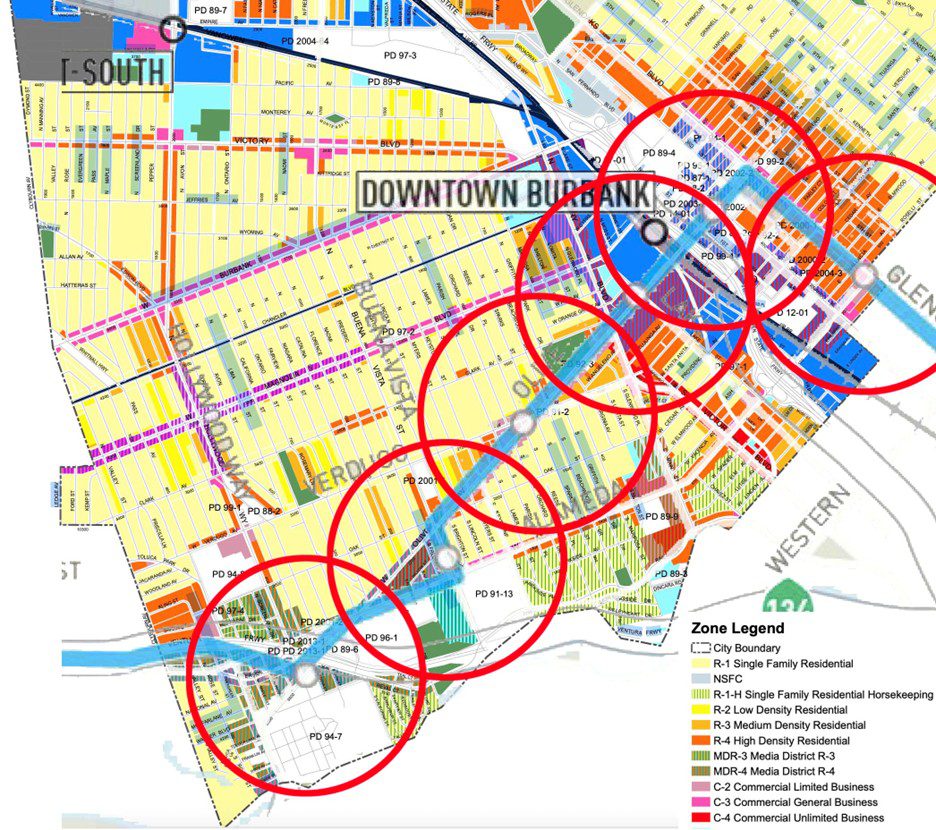
LOCATION OF BURBANK BRT STATIONS AND AREAS WITHIN ½ MILE (areas in yellow are Single-Family neighborhoods)
The potential for a rapid increase in density



without a corresponding plan for infrastructure development likely places a severe strain on our sewer, power and water systems, and public services. These were never designed for this kind of density from randomly placed developments.
According to the current Burbank Housing Element, in 2020 Burbank had 44,978 residential units, including 19,908 detached single-family homes. When the Housing Element was adopted in 2022, the Environmental Impact Report for it calculated that the city’s sewer capacity was inadequate for the forecasted number of new housing units. The EIR for the City’s Housing Element found that by adding — the City’s commitment for —12,000 additional housing units, Burbank’s sewage treatment capacity would be exceeded by 2,300,000 gallons per day.
SB79 would prohibit the City from doing anything that would limit development to less than 100 dwelling units per acre within ¼ mail of BRT stations and 80 dwelling units per acre (DU/acre) within 1/4-1/2 mile on single-family and commercial lots. That means that SB79 allows for the development of up to 35,210 to 42,760 dwelling units in the ½ mile radius circle around a single BRT station. It is the equivalent of nearly doubling Burbank’s entire housing stock within ½ mile of one single BRT station (fn 1). 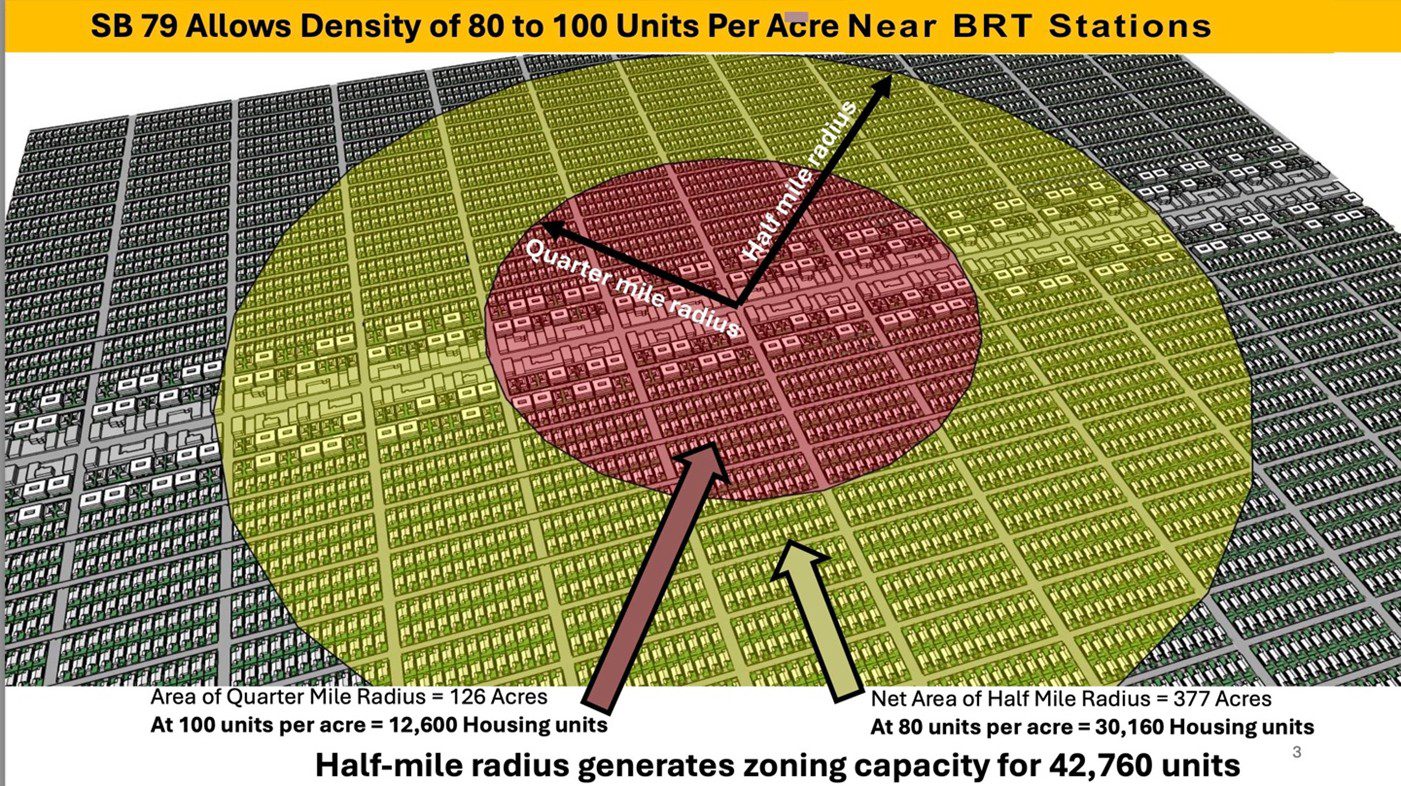
DENSITY ENCOURAGED UNDER SB79
Source: United Neighbors
SB79 could therefore result in an increase of up to 38,200 units around a single BRT stop, or three times the number of additional units that results in 2,300,000 more daily gallons of sewage than Burbank can handle now.
There are multiple BRT stations proposed for Burbank. While the numbers above are rough calculations and for comparative purposes only, clearly SB79 will impact the City’s infrastructure, including sewage, water and electrical services. Moreover, SB79 densification would happen throughout the County and the State, and in other parts of Burbank. So, infrastructure capacity is likely to be an issue not only in Burbank, but in neighboring cities, the County and State if SB79 passes.
Not only will sewage treatment capacity be impacted but the sewer pipelines in some areas may not be able to handle the additional flows. According to page 2-224 of the EIR for the Housing Element: “… the City may utilize a sewer tributary flow path that has available capacity for several additional housing units; whereas a separate location that is only a block away may utilize a very different tributary sewer flow path that cannot support any additional housing units.”
SB79 limits the ability of cities to redirect SB79 densification to other parts of the city.
And an April 22, 2025 report to Council on the Burbank’s Sewer System Management Plan stated:
The (Plan) requires flow monitoring inside sewer pipelines during the wet and dry seasons (completed); evaluation and computer modeling of the collection system (ongoing), and a capital improvement plan for the development and prioritization of future capital improvement projects needed to increase sewer capacity in the collection system and at the Burbank Water Reclamation Plant (BWRP). This work has been complicated by the growing and dynamic demands of meeting the state-mandated increases in housing units and assessing the site-specific impacts to the sewer system related to private development projects at opportunity sites.
In addition to the Public Works Department, our Water and Power Department (BWP) is required to plan for its capital improvements and upgrades to the power system in a similar fashion, using new housing unit forecasts to determine the demand on the electric distribution system and its total power capacity. For electrical service, developers must submit an analysis, method of service, impacts to the system, upgrades needed, cost to provide new service and cost to mitigate or upgrade impacts to the system, etc. in compliance with BWP’s Rules and Regulations for electrical service.
At a memorable BWP staff presentation to City Council, the power engineer recounted what this looks like: instead of 4 “pulls” off of a power line — typical for single family service to four homes — current laws necessitate multiple additional “pulls” to meet new housing unit demand. Considering SB79 opens the doors to randomized development of 10 or more housing units per each single-family lot, how will BWP — our award-winning well run municipal utility — even be able to plan and respond?
Even the most ardent pro-development advocate would concede that SB79 undermines local government’s ability to rationally plan and construct adequate infrastructure.
SB79 drops new development into our neighborhoods at random – locations Burbank never planned for. This makes it hard for a City to develop impact fees to deal with the infrastructure impacts of specific developments, particularly given the recent changes in impact fee justification and study requirements (see SB937, 2024). Burbank is not alone in facing more unplanned demands on sewer, power and water capacity. The legislation’s lack of any provisions for dealing with the infrastructure impacts of SB79 is a fatal flaw in this legislation and another reason for asking our representatives to vote “NO” on SB79.
SB79 will destroy single-family neighborhoods and challenge our City’s ability to meet the infrastructure needs of our community. Please help us defeat SB79.
I believe that a Housing Element — like that adopted by the City of Burbank — which was found 100% compliant by the State of California in accordance with the State’s OWN housing requirements, and subsequently faithfully implemented at the local level through implementation ordinances for all of the Housing Element’s identified sites, deserves a complete exemption from SB79. Unlike SB79, the City’s Housing Element is designed to foster affordable housing and allows for planning for critical infrastructure needs.
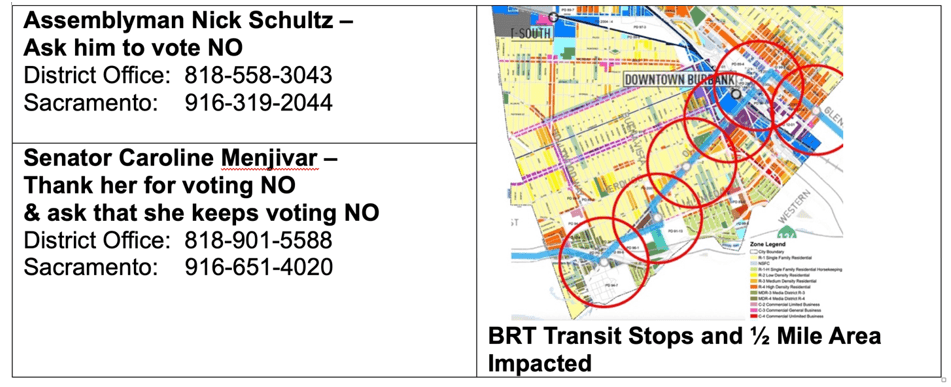
Help keep Burbank, Burbank. Please contact your State Representatives and ask them to vote against SB79. You can find your State Representatives at: https://findyourrep.legislature.ca.gov
For Burbank, contact:
Emily Gabel-Luddy
Former Burbank Mayor
Footnote:
(fn 1) Assuming an average current lot size of 7,260 sf and an average of 1.5 units per lot, there are currently an estimated 4,525 housing units existing within ½ mile of the Olive/Verdugo BRT stop along Olive Avenue. Development at full SB79 density could result in 42,760 units.
Development at 10 units (the number of units per development exempt from affordable housing requirements and thus the number developers are likely to build) per 7,260 sf lot would result in an estimated net new 35,210 units.
Even at one-third of the forecasted density increase for about 11,700 new units, SB79 destabilizes our city’s good faith efforts to meet the requirements for expanded sewer capacity.










This, from one of the politicians whose short sighted, NIMBY policies got us into this mess in the first place. The nerve…
Comments are closed.