Letter to the Editor:



SB79 WILL DESTROY NEIGHBORHOODS AND WILL NOT SUBSTANTIALLY INCREASE TRANSIT RIDERSHIP
SB79 is a proposed State law that would encourage developers to buy up single-family homes within ½ mile of a major transit stop and replace them with high-density market-rate or luxury apartments or condos. At the State Assembly Local Government Committee public hearing held on July 16, 2025, the bill’s sponsor, Bay Area Senator Scott Wiener, opened his remarks by identifying transit as the driving force for the increased density goals of SB79, saying:
This is really what this bill, bottom line is about, is when we are making significant public investments in public transportation – we’re making these very significant taxpayer investments in public transportation – are we going to actually build enough housing around them so that people can walk to them and use them and we can have the ridership we need for them to succeed?”
So, neighborhoods are going to be destroyed in order to try and generate sufficient ridership to justify the large expenditures of taxpayer dollars for transit that the public prefers not to ride. Metro spends about $1.7-$2.1 billion dollars a year in capital costs, and another $1.87-$2.2 billion a year in operating costs. The BRT for example will cost upwards of $317 million dollars to have a dedicated bus lane, rather than Metro just operating a standard bus on the route, and because the BRT is unlikely to have sufficient ridership, the State wants to developers to tear down single-family homes along the alignment and replace them with high-density apartments. As presented, SB79 is a case of trying to make people serve transit, rather than transit serve people. But will SB 79 actually help to increase transit ridership? The answer is: probably not.



Who Are The Typical Transit Riders
According to us Access and Income in LA County (2021), bus riders in the LA region tend to be lower income:
According to LA Metro, the median and mean household incomes of bus riders in the County of Los Angeles in 2019 was $17,975 and $27,723 respectively with 57% of riders living below the poverty line. The agency reported in 2019 that the median and mean income for rail riders was $27,723 and $45,421 with 38% of riders living below the poverty line. In addition to the socioeconomic statistics, Metro reported that 66% of bus riders are Latinx and 15% are Black/African American. While it is clear that transit riders as a whole in Los Angeles have lower-incomes, bus riders in particular are more socioeconomically vulnerable than their rail rider counterparts.
Transit Ridership Has Been Decreasing – Why?
SB79 is theoretically an attempt to prop-up transit systems which were experiencing decreasing ridership even before the pandemic. In today’s post-pandemic world, more people work from home, transit is perceived as unsafe, there are ever-more extreme heat days, there are more attractive options such as uber or car ownership, and people worry about disease transmission in confined or dirty spaces, so transit is not appealing.
On the Metro system, the number of unlinked passenger trips per year has fallen from 476.3 million in 2013 down to 276.3 million in 2023, according to Metro’s Annual Agency Profile submitted to the Federal Transit Administration. An Unlinked Passenger Trip (UPT) is the number of passengers who board public transportation vehicles. Passengers are counted each time they board vehicles no matter how many vehicles they use to travel from their origin to their destination.
Studies of decreasing transit ridership such as Falling Transit Ridership: California and Southern California, have examined a number of factors. According to Falling Transit Ridership:
We examine patterns of transit service and patronage over time and across the region, and consider an array of explanations for falling transit use: declining transit service levels, eroding transit service quality, rising fares, falling fuel prices, the growth of Lyft and Uber, the migration of frequent transit users to outlying neighborhoods with less transit service, and rising vehicle ownership. While all of these factors probably play some role, we conclude that the most significant factor is increased motor vehicle access, particularly among low-income households that have traditionally supplied the region with its most frequent and reliable transit users.
So, even if SB79 was effective in generating a concentration of low-income housing around transit, that is unlikely to cure the problem of decreasing transit ridership in the greater Los Angeles region.
SB79 Will Not Produce The Low-Income Housing Needed to Increase Transit Ridership
However, SB79 will not produce much in the way of low-income housing. SB79 will let developers build 5-6 story buildings at a density of 100 dwelling units per acre within ¼ mile of BRT stops and 80 dwelling units per acre within 1/4-1/2 mile on single-family lots. The first 10 units on any lot are exempt from affordability requirements and units in an SB79 project can be an average of 1,750 square feet (sf) in size.
By way of comparison, the Pickwick Project has a site density of just under 19 dwelling units per acre. According to the Pulte Homes website, the Pickwick units are 1,725-1,830 square feet (sf) in size. Pickwick’s 1,725 sf units sells for $1,358,990. SB79 is not affordable or low-income housing legislation.
Most lots along the BRT alignment are 5,500 – 8,000 sf in size. So, on a 6,000 sf lot within ½ mile of a BRT station a developer could put 10 units of 1,500 sf, or 10 units of 1,750 sf on a 7,000 sf lot without needing to provide any low-income or affordable housing and this would be consistent with SB79. SB79 is not affordable housing legislation and is not designed to produce low-income housing.
Market-Rate And Luxury Housing Does Not Generate Transit Ridership
While a stated goal of the bill is to increase public transit ridership, its focus on building market-rate and luxury housing works against that goal since it will not house the very people who rely the most heavily on public transportation. According to page 5 of a 2019 study, Falling Transit Ridership: California and Southern California:
The average resident of the SCAG-region made about 35 transit trips in 2016, but the median resident made none. Only a minority of the population rides transit very frequently or even occasionally. About two percent of the population rides transit very frequently (averaging 45 trips/month), another 20 percent of the population rides transit occasionally (averaging 12 trips/month), and more than three-quarters of SCAG-region residents ride transit very little or not at all (averaging less than 1 trip/month). Heavy transit use, moreover, is concentrated among the low-income population, and especially low-income foreign born residents.
According to the Southern California Association of Governments’ (SCAG) Connect SoCal 2024 Performance Assessment Results, in 2019 only 3.4% of work trips and 3.6% of all trips were by transit. Given that SB79 allows for the construction of 10 large market rate or luxury units on a single-family lot, with no provision of affordable housing, and only requires a minimal amount of affordable housing for developments of 11 or more units which must provide only 7% extremely low-income, or 10% very low-income, or 13% low-income units, SB79 is unlikely to substantially increase the share of trips in the region which are by transit. Developers like to maximize profits and rents and are therefore likely to include low-income housing in their developments.
SB79’s obsessive focus on “securing” transit riders to raise the return on transit investment is not only badly misplaced but unachievable given that little or no affordable housing will result from the bill as amended on July 16. SB79 actually works against increasing transit trips by undermining the ability of cities to meet their much higher low-and-moderate-income housing targets in their Housing Elements or to implement their transit-oriented development policies which are designed to result in a much larger share of low income and affordable housing. Developers will instead invest in 10-unit SB79 housing and avoid provision of low-income housing units.
If SB79 is serious about generating transit ridership it would need to be amended to require that each SB79 development match the low-income percentage targets assigned by the State, in each local jurisdiction’s Housing Element. For Burbank that target is 29.1% very-low income, and 16.2% low income and 16.1% moderate income, leaving 38.7% of units to be above moderate income. Failure to require meaningful low-income housing production is a “tell” that SB79 is not about helping transit.
So, Who Does SB79 Benefit?
SB79 will replace stable single-family neighborhoods with high-density market rate and luxury apartments and condos, which may or may not include parking. It is unlikely to significantly increase transit ridership since few of the units produced will be low-income. SB79 will, however, decrease homeownership in California to the benefit of developers, real estate speculators and large rental companies, and drive up the cost of single-family homes as families compete with developers for these houses. The units produced will be exempt from rent control for their first 15 years. Developers will likely produce SB79 housing rather than comply with City Housing Element policies designed to increase the area’s share of low-income and affordable housing. Given the densities allowed by SB79, SB79 development will likely impact local services and infrastructure. There are limitations on how much of the infrastructure costs imposed by this development can be charged to the SB79 developments, leaving taxpayers to hold the bag. Developers benefit, and Burbank residents and families loose. Don’t buy the SB79 hype; SB79 is designed to benefit developers at the cost of neighborhoods.
Help keep Burbank, Burbank. Please contact your State Representatives and ask them to vote against SB79. You can find your State Representatives at: https://findyourrep.legislature.ca.gov
For Burbank, contact: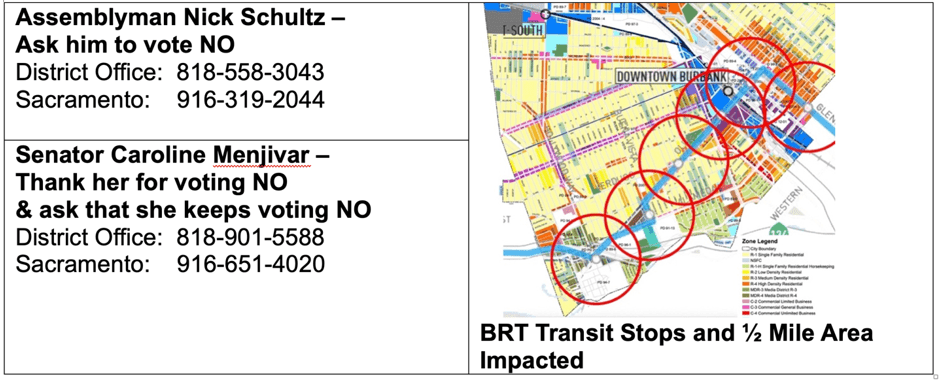
Susan O’Carroll
Burbank