




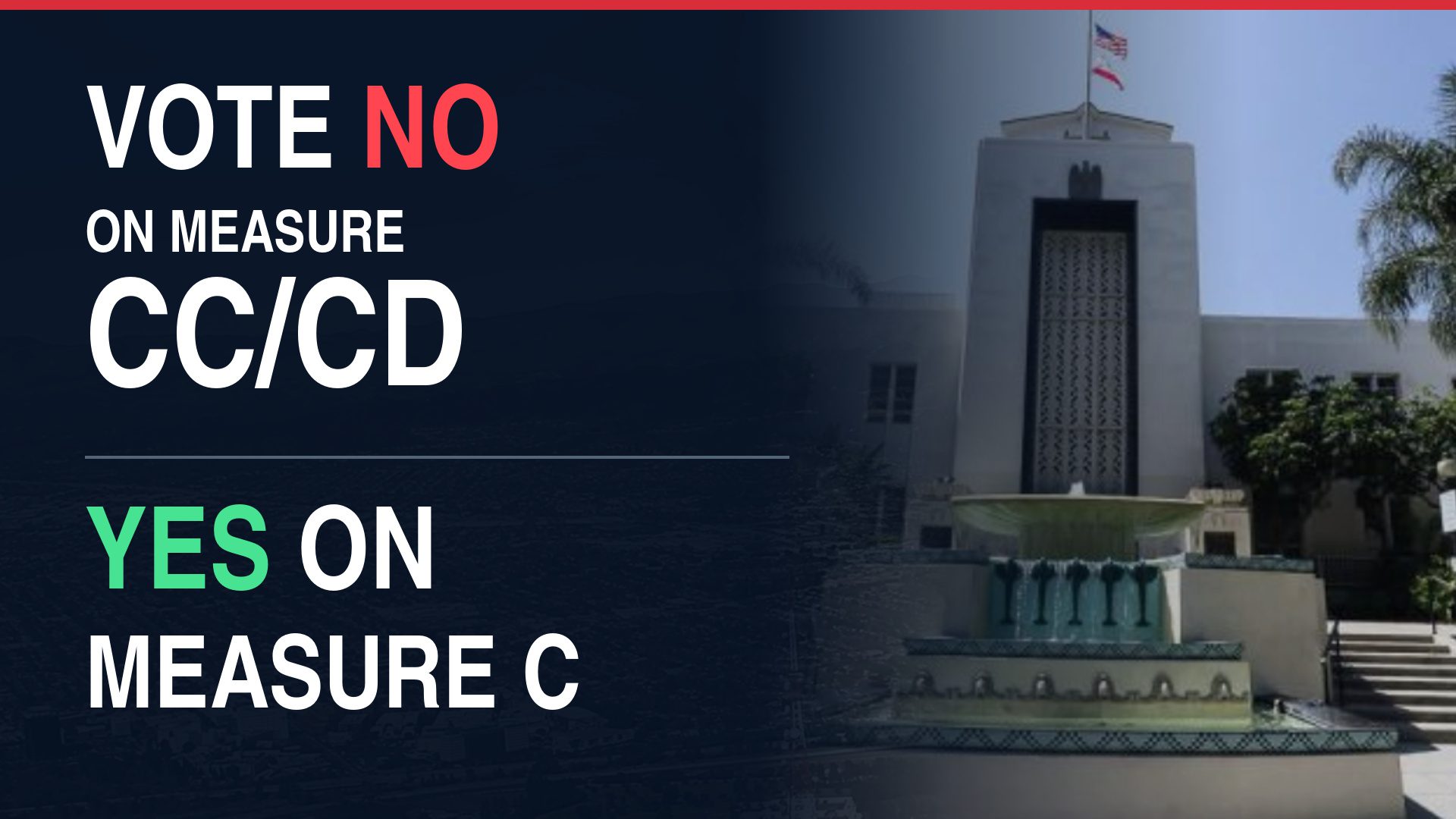
Burbank does not need City Council districts. It needs five council members who answer to the entire community—and voters who retain the authority to decide how those council members are elected.


That is why I urge a no vote on both Measure CC and Measure CD.
These measures address different questions, but together they could fundamentally change the relationship between Burbank residents and their elected representatives. Neither change is one I believe our city needs.
Today, every Burbank voter can help choose every member of the City Council over the course of its staggered elections. We vote for three seats in one election and two in the next. Every council member faces the same citywide electorate.
Under the district system proposed by Measure CD, your vote would be limited to the single council seat assigned to your geographic district. You would vote for that representative once every four years. You would have no vote in choosing the other four council members, even though their decisions would still affect your neighborhood, your city services and Burbank’s future.



That is a substantial loss of electoral influence.
Supporters of districts may argue that a neighborhood gains a representative of its own. My concern is what residents give up in exchange: the ability to hold all five council members accountable at the ballot box.
A district boundary would not prevent you from contacting another council member. But contacting someone and having a vote in whether that person keeps their job are two very different things.
I want every council member to have a reason to listen to every Burbank resident.
The Risk of Dividing a Small City
Burbank is a small city with shared concerns. Traffic, public safety, development, infrastructure and city finances do not stop at district lines.
Dividing the electorate into five pieces could encourage council members to focus on securing something for their own districts instead of considering what serves Burbank as a whole.
My concern is that projects could become bargaining chips: support mine, and I will support yours. Cooperation is necessary in government, but the public deserves decisions based on a project’s merits, with the reasoning explained openly.
District elections do not automatically produce backroom deals or corruption. But they do not protect us from those problems, either. We should question whether creating smaller political territories would make our council more accountable—or simply change how influence is exercised.
The same concern applies to campaign money. A developer or other outside interest could concentrate resources on a race involving only a portion of Burbank’s voters while seeking decisions that affect the entire city.
Outside influence is a concern under any election system. I do not see how reducing the number of voters a candidate must answer to solves it.
What Problem Are We Solving?
The City Attorney’s analysis states that these measures arose from a settlement of litigation under the California Voting Rights Act.
That explains why the question is on the ballot. It does not, by itself, persuade me that districts would improve Burbank’s government.
Our community has elected council members of different genders and ethnic backgrounds through citywide elections. That alone does not settle every question about representation, but it should be part of an honest discussion about whether our system needs to be replaced.
Before surrendering the ability to vote for all five council seats, residents should demand a clear explanation of how having a vote for only one would better serve them.
Consider the school board’s move to district elections. Do you know which school board district you live in? Do you know when you can next vote for its representative? Do you feel more connected to the board because of that boundary?
Those are practical questions about whether districts deliver the engagement and accountability their supporters promise.
Measure CC Deserves Just as Much Attention
Voting against Measure CD is only half the decision.
Measure CC would remove the City Charter’s requirement that council members be elected at large. According to City Attorney Joseph McDougall’s impartial analysis, the election method could then be established by an ordinance adopted by the council or the voters.
The analysis specifically explains that, even if Measure CD fails, approval of CC would allow the council or voters to adopt a different district election ordinance and map.
Think about that: voters could reject the district proposal on this ballot while giving the council authority to adopt another one.
CC would not give the council unlimited power to rewrite the Charter, and changing election methods by ordinance would not mean public input disappears. But it would remove the existing requirement that voters approve a Charter amendment to change the at-large system.
To me, that distinction is decisive. Public comment is valuable. The public’s final say is more valuable.
Supporters call CC flexibility. I believe the method we use to elect our representatives is important enough to keep under direct voter control.
If both measures pass, district elections under Map 130 would begin with Districts 2 and 4 in 2028, followed by Districts 1, 3 and 5 in 2030. If both fail, our current at-large system remains.
Burbank’s government is not beyond criticism. But dividing the city into districts is no guarantee of better representation, better judgment or greater fiscal responsibility.
Every resident should have a vote in choosing the entire council. And voters should retain the power to approve any departure from that system.
Keep Burbank’s elections at large. Vote no on Measure CC and Measure CD.
Vote Yes on Measure C—Visitors Should Help Support Burbank
Measure C should be a no-brainer for Burbank voters.
When visitors put their heads on pillows in our hotels and motels, they get more than a room. They benefit from our fire department, police department, emergency response and the city services that make Burbank a desirable place to stay.
People get more when they stay here. Asking them to contribute a little more toward those services is reasonable.
Measure C would increase Burbank’s hotel tax from 10% to 12%, generating an estimated $3 million annually in locally controlled funding. That money could help maintain public safety, parks, recreation programs and other essential services.
For someone booking a $200 room, the increase amounts to $4 per night. That is a modest contribution toward maintaining the community surrounding their hotel.
This would be Burbank’s first hotel tax adjustment since 1983. The cost of providing city services certainly has not stood still for more than four decades. Our revenue policies should reflect that reality.
According to the city, the proposed rate would also bring Burbank in line with nearby Glendale and Pasadena.
The tax is paid by hotel and motel guests, including residents who book local stays. Residents would not pay it simply because they live in Burbank.
Visitors use our roads, public spaces and emergency services. They should help support them alongside the residents and businesses already investing in this community.
City Hall must still spend responsibly and explain how this additional revenue benefits Burbank. Supporting Measure C does not mean giving officials a pass on accountability.
It means recognizing that maintaining a quality city costs money, and visitors share in the benefits.
Burbank offers real value to those who stay here. A modest increase in the hotel tax is a fair way to help preserve it.
Vote yes on Measure C.
Craig Sherwood, Executive Editor, President of myBurbank.com Inc.











Yes on CC and CD, No on C: A Friendly Disagreement
A reply to the myBurbank opinion piece of October 23, 2026, point by point.
Craig, I read your piece on Measures CC, CD and C with interest. You make your case clearly, and I respect that. I see it differently, and I would like to explain why, point by point. I am voting yes on CC, yes on CD and no on C.
One thing first, offered in good faith. When I asked you in January 2023 to do a story on the expensive food spread at a Burbank City Water and Power board meeting, paid for by ratepayers, you told me Water and Power was one of your largest advertisers. Measure C would add to the City’s general fund. I think readers would appreciate knowing whether the City or Burbank City Water and Power still advertises with myBurbank. A simple disclosure would settle it.
You wrote: Today you help elect all five council members. Under districts you would vote for one, every four years.
My view: You can still help anyone in town get elected. Nothing stops you from giving to, walking for or volunteering for any candidate you like. But people in different neighborhoods care about different things. I have lived here almost my entire adult life. I married here and raised my children here, and my wife and I work here. I know this town. Burbank is not one neighborhood. Some streets have horses. Some sit under the flight path. Some sit next to the freeway and the office towers. Some are all apartments and some have none. A district gives each neighborhood one person whose job is to answer to it.
You wrote: You can contact any council member, but you could only vote out your own.
My view: I think that is a strength. One neighborhood, one member, one name to call. That is accountability you can see.
You wrote: Burbank is a small city. Traffic, safety, development and finances cross district lines.
My view: Burbank is small in square miles, but not in dollars. Outside committees spent more than $300,000 in the last council election alone. Every member would still vote on citywide matters. Districts change who they answer to, not what they vote on. People with big checkbooks would have far less say over what our council members do. And people with a heart to serve could win a seat on the council, instead of people who are put there by big money.
You wrote: District members will chase wins for their own district instead of the whole city.
My view: Looking after a neighborhood is part of the job. What concerns me more is the cost of a citywide race. Three of the last seven council winners spent more than $50,000, for a seat with base pay of less than $23,000 a year. A person with a heart to serve and no donor list has a hard time competing.
You wrote: Districts invite vote trading and do not prevent backroom deals or corruption.
My view: No system prevents those things, including the one we have now. But ask yourself why anyone would need hundreds of thousands of dollars from donors for a job that pays less than $23,000 a year. In the last council election, more than $200,000 was spent to elect just one of our current council members. I think the answer is simple. Folks are trying to buy influence. That is not what the City Council is about. It is about serving the people, not serving special interest groups. I would also point to results. In fiscal year 2025, 414 City of Burbank employees were paid more than a United States senator ($174,000). 167 were paid more than the Governor of California ($242,295). 18 were paid more than the President of the United States ($400,000). We are told these are competitive wages. But the unions that represent many of these same employees help elect the council members who approve their contracts. In the last council election, a firefighters’ political action committee and a committee sponsored by an electrical workers union together spent more than $130,000 to elect council members. That kind of money pays for the big mailers, and my wife and I have a stack of them in our living room. City overtime was almost $22 million in 2025, up 80 percent since 2020, and 42 City employees were paid more than $100,000 in overtime. Burbank City Water and Power accounted for nearly half. A council member who answers to a neighborhood, not to a citywide fundraising network, may be freer to ask about it.
You wrote: Citywide elections have already produced council members of different genders and backgrounds.
My view: I do not think we should pick council members by group. We are all Burbank residents. The diversity that matters is in where people live, what they do for a living and what they see on their own street. Today the people who win tend to be the ones who can raise the most money. Districts would open the field to anyone with a heart to serve, whoever they are and wherever they live in town.
You wrote: Do you know your school board district? Districts did not get more people involved there.
My view: Elections by district are how we now choose our school board, and the feedback has been very good. Several candidates have said they never would have run if they had to raise a lot of money and chase votes all over the city. Because they only have to walk their own neighborhoods and raise a small amount of money, they could run, and win. A 2024 school board winner spent less than $2,000. That is encouraging for a process this new. And there is no reason for Burbank to have two different voting systems. Electing the school board by district and the City Council citywide is confusing. The City Council should be elected by district too.
You wrote: Districts guarantee nothing: not better representation, judgment or fiscal responsibility.
My view: Agreed, nothing guarantees good government except good people doing good work. Districts lower the cost of getting those people a seat at the table. Look at the mailers on your kitchen table and who paid for them. Much of it is the same few sources every election.
You wrote: Measure CC takes the method of electing the council out of voters’ hands. Even if CD fails, the council could adopt districts by ordinance.
My view: That is a fair concern. I do not like handing power to a few people either. But the City wrote these measures so that CD cannot take effect without CC. For anyone who wants districts, the answer is yes on both.
You wrote: A 12 percent hotel tax brings Burbank in line with Glendale and Pasadena.
My view: Burbank does not need to match its neighbors. Our hotels and motels already pay the City plenty. The hotel tax is a percentage of the room rate, so it rises every time room rates do, without anyone voting on it. At the same 10 percent rate, Burbank’s hotel tax brought in $2.5 million in fiscal year 1999 and $13.2 million in fiscal year 2024, more than five times as much (City budget and annual financial reports). Hotel guests also pay a separate tourism district assessment on every room night. On top of that, hotels pay property tax on their buildings and sales tax on what they sell in their restaurants and bars. These businesses already generate millions of dollars a year for the City. Measure C is one more hit on local business.
Our hotels have had a hard few years. During COVID they were nearly shut down, and the City’s own numbers show it: hotel tax revenue fell from $11.1 million in fiscal year 2019 to $5.5 million in fiscal year 2021. Then came the January 2025 fires. Under the Governor’s emergency declaration, state law (Penal Code section 396) barred hotels from raising room rates more than 10 percent above their pre-fire prices through March 8, 2025, and the Attorney General sent warning letters to more than 200 hotels and landlords. Meanwhile their costs kept climbing. In a survey of about 2,600 U.S. hotels, CBRE found insurance costs rose 17.4 percent and labor costs rose 4.8 percent in 2024 alone.
And a 12 percent tax is more than many hotels earn. Publicly traded hotel and gaming companies in the United States had an average net profit margin of 10.38 percent (NYU Stern School of Business, Aswath Damodaran, January 2026). Under Measure C, the City would collect 12 cents on every room dollar, more than the average hotel company keeps as profit. When the tax makes a room cost more, it is the hotel that loses the booking.
The City also takes a share of every Burbank power bill. Two City charges on Burbank City Water and Power electric bills add up to 14 percent: a 7 percent Utility Users Tax and a 7 percent In-Lieu Transfer. Both go to the City, and the In-Lieu Transfer alone sent more than $10 million to the general fund last fiscal year. Electric rates went up 9.9 percent this January and go up another 9.9 percent next January, so the City’s 14 percent grows with them.
The real problem is spending. In fiscal year 2024-25 the City budgeted $12.0 million for overtime and spent $26.1 million, a $14 million overrun that is almost five times what Measure C would raise in a year (City of Burbank budget books). A person familiar with the matter says the City would rather raise taxes than face a difficult conversation with the labor unions. There is nothing wrong with City workers. But someone has to take a haircut to get the budget in check, and it should not be our hotels.
Thank you for the conversation, Craig. I am voting yes on CC, yes on CD and no on C, and I hope my neighbors will too. Ballots are due by Tuesday, November 3, 2026, by mail or at any vote center or drop box.
Joel Schlossman
Burbank
Reply, Reply All or
Comments are closed.