By the Law Offices of Adrianos Facchetti


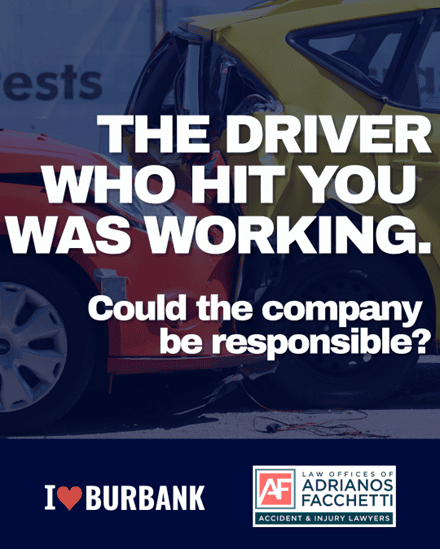
Spend a few minutes driving through Burbank and you will share the road with delivery vans, contractor trucks, studio vehicles, airport shuttles, and employees traveling between jobs. Most trips end without a problem. But after a serious collision, one detail can change the questions that need to be asked: Was the other driver working at the time?
At the Law Offices of Adrianos Facchetti, we look beyond the name on the driver’s license when a crash causes significant injuries. Sometimes the claim involves only the driver. In other situations, a business or another insurance policy may also need to be considered. The answer depends on what the driver was doing, why the trip was being made, and the relationship between the driver and the company.
Why does this matter? If the driver was performing work duties, responsibility may not stop with the person behind the wheel. Identifying everyone who may be involved can affect which insurance policies are available and what evidence should be preserved. That can be especially important after a crash involving hospitalization, significant time away from work, or ongoing medical care.
When Can a Company Be Responsible for a Driver’s Actions?
A company may sometimes be responsible when an employee causes a collision while performing work duties. The basic idea is familiar: businesses send people onto the road to make deliveries, visit customers, transport equipment, or travel from one work location to another. When a serious crash happens during that work, the driver’s actions may not be the only part of the picture.



That does not mean a company is automatically responsible every time an employee is involved in an accident. A logo on a vehicle, a uniform, or a company name mentioned at the scene can be important, but none of those facts answers the question by itself. The purpose of the trip and the amount of direction or control the company had may matter. So may the ownership and maintenance of the vehicle.
Was the Driver Actually Working at the Time of the Crash?
The fact that someone has a job is not enough. The important question is what that person was doing when the collision occurred. A driver heading from a business to a customer’s property may present a different situation from an employee using the same vehicle for a personal errand. A trip can also have more than one purpose, which makes a quick answer difficult.
The vehicle does not always settle the issue. Some employees drive company vehicles, while others use their own cars for deliveries or travel between worksites. A driver may also be described as an independent contractor, which can raise additional questions about the working relationship.
What Evidence Can Connect the Driver to the Company?
After a serious crash, ordinary photographs can preserve more than vehicle damage. They may show a company name, vehicle number, license plate, equipment, delivery materials, or other details that later help identify who was involved. Witness names, the police report, and the insurance information exchanged at the scene can also become important.
Businesses may have records that cannot be seen at the roadside, including dispatch information, schedules, route data, vehicle records, or communications with the driver. Some information may be overwritten or become harder to obtain as time passes.
You do not need to confront the company or conduct your own investigation. Save what you observed, and an attorney can determine which additional records may be relevant.
What Should You Do After a Serious Crash With a Working Driver?
Call 911 when anyone is injured or the crash creates a hazard. Get medical attention, exchange complete driver and insurance information, photograph the vehicles and surrounding area, and collect witness contact information when possible. If the other driver says they were making a delivery or working for a business, include that fact when you document what happened.
Be accurate when speaking with an insurance company, but do not guess about the driver’s job status, the company’s responsibility, or the full extent of your injuries. A business being connected to the trip does not guarantee a particular outcome or amount of compensation. It simply means the crash may require a broader investigation than it first appears.
The safest approach is to preserve the information early and avoid signing a final agreement before you understand who may be involved. That is especially important when a collision results in hospitalization, surgery, significant time away from work, or injuries that may require ongoing care.
The Law Offices of Adrianos Facchetti represents people injured in serious car, truck, delivery vehicle, motorcycle, pedestrian, and bicycle accidents throughout Burbank and greater Los Angeles. The firm offers free consultations at (626) 793-8607 or facchettilaw.com/contact.
About Adrianos Facchetti. Adrianos Facchetti is a Burbank personal injury attorney, the founder of the Law Offices of Adrianos Facchetti, and a Transportation Commissioner for the City of Burbank.
This article provides general information, not legal advice. Responsibility after a crash depends on the facts, working relationship, insurance coverage, and applicable law.
Links and Sources
Law Offices of Adrianos Facchetti: Passenger injury claims in California
Law Offices of Adrianos Facchetti: Recorded statements to the other driver’s insurer
Law Offices of Adrianos Facchetti: Steps after a motor vehicle accident